March 17, 2022

Ancestors Who Fought in the Revolution – part 1

I thought that members of my family might be interested hearing about some of our ancestors that have been documented as having been involved in the Revolutionary War.  All of the ones that I know about are on the New England branches of my father’s family and have been pretty well documented.  So far, I have found nine direct ancestors along three branches of our family tree that fought in the Revolution.  These gentlemen range from a 3rd great grandfather to a couple of 5th great grandfathers.

In this series of three blog posts, I am planning to include short biographies about the Revolutionary service for these direct ancestors:

Abraham Howland (1762-1853), a 3rd great grandfather

Samuel Scribner (1735-1815), a 4th great grandfather

Stephen Staples (1739-1798), a 4th great grandfather

Joseph Ricker, Jr (1746-1825), a 4th great grandfather


James Smith, Jr (1732-1798), a 5th great grandfather

John Rogers (1760-1796), a 4th great grandfather

Nathaniel Dickinson (1749-1797), a 4th great grandfather


Aquila Hall (1750-1815), a 4th great grandfather

Walter Tolley (~1715-1783), a 5th great grandfather


While there are no names of any female ancestors on the above list, the women, mothers and wives and families of these ancestors were involved in ways that supported the efforts of their men and the Revolution as they struggled for Independence from Britain.

This first blog post will begin with my direct ancestors that lived in Massachusetts and Maine.  Maine was a part of the Commonwealth of Massachusetts until 1820.  Most of the place names noted below were a part of the Commonwealth of Massachusetts at the time of the Revolution, though now many are located in Maine.


Abraham Howland (1762-1853) was a direct descendent of John Howland & Elizabeth Tilley, both passengers on the Mayflower and mentioned in a few of my earlier blog posts.  Abraham was also a descendant of one of John Howland’s brothers, Henry Howland, who arrived several years after the Mayflower.  Abraham’s mother was a direct descendent of John Howland, and his father was a direct descendant of Henry Howland, John’s younger brother.

Abraham was born in Pembroke and moved when he was 5 years old with his family to Topsham in the Commonwealth of Massachusetts.  When he was only 16 years old he joined a Revolutionary militia in Topsham.  Abraham served in 1779 as a Private with Capt Aster Patten and under Col Samuel McCobb and participated in a mission afterwards known at the Penobscot Expedition.  The troops traveled to Bagaduce on the Penobscot Bay where they attacked the British troops and proceeded to Cox’s Head on the Kennebec River where he assisted with the building of a fort.  At the expiration of his service he returned home to Topsham.  Abraham’s service was documented and he was granted a pension at the end of the War. 

In 1787 Abraham married Anna Staples in Topsham where they lived and raised at least 12 children that lived to adulthood.  Abraham’s father-in-law, Stephen Staples also fought in the Revolution.


Stephen Staples (1739-1798) was born and raised in the town of Falmouth, Massachusetts.  He married Judeth Morrill in Topsham in 1760 and they had 2 children before Judeth died.  He then married Susannah Hobbs in 1764 and they had 9 more children including a daughter, Anna, through which my line descends.

Records indicate that Stephen Staples joined the Continental Army on or before 1777.  He served in regiments with Capt Lane’s Company, Col Ichabod Alden’s 6th regiment, and Capt Daniel Lane’s Company.  He was included on muster rolls at Cherry Valley in 1778 and also with Capt Asa Coburn’s Light Infantry Company in 1779 at Fort Harkimer.  The Continental Army pay accounts for the service of Stephen Staples date through 1780. 

Stephen died in 1798 at Topsham, Massachusetts.  Five years after Stephen’s death, Susannah Hobbs Howland married again, but had no more children.  She died in 1824 in Topsham, Maine.


Samuel Scribner (1735-1815) was born in Exeter, New Hampshire and was a resident of Massabesic. He married Sarah Bucknell in 1764 in Somersworth, New Hampshire and they settled in York County, Massachusetts.  Their family eventually grew to 10 children of which 6 reached adulthood. 

When Samuel was about 40 years old, he enlisted in July 1775 at Hollis, Massachusetts, and he served 8 months in the Revolutionary War with the Massabesic Militia Company.  Later, in 1778, he served with the 3rd York County Regiment in Capt John Smith’s Company.  He also appears in Revolutionary War pay documents in August 1778 as a Private in Capt Ebenezer Webster’s Company, Col Nichol’s Regiment, Gen Whipple’s Brigade of the New Hampshire Volunteers who participated in the Expedition to Rhode Island.  According to a letter written by Samuel’s grandson, “he [Samuel] saw hard service in that war [Revolution] and was a noble soldier.”

Samuel Scribner had a distinguished life, and I plan to write a blog post about him and his endeavors at a later time.  He died in 1815 on his farm in Waterborough, York County, Massachusetts at 80 years of age.


Joseph Ricker, Jr (1746-1825) was born in Berwick, York County near the New Hampshire border.  Joseph Ricker Jr’s grandfather, Maturin Ricker, was born in St Brelade, Isle of Jersey, one of the Channel Islands in England.  He came from England to America with his brother in 1670 and was an early settler in New Hampshire.  Both brothers were killed by an Abenaki Indian raiding party in 1706 while working in the fields.  Maturin’s youngest son was carried away by the Indians but his wife, Rebecca Shaw Ricker, and another son, Joseph, survived to raise his family in the territory.

Before the Revolution began, in 1767, Joseph Ricker Jr married Deborah Wentworth in York County, Massachusetts where they raised a family spanning the time before, during and after the Revolution and had at least 7 children that survived into adulthood.

Joseph Ricker Jr was commissioned in 1776 as a First Lieutenant with Capt Samuel Grant’s 3rd Berwick Company; and he also served as a captain with Col J Godwin’s 2nd York G Company, 6th Regiment in 1780.   


My next blog post will focus on several of my direct descendants from the New London area in Connecticut that participated in the Colonial campaign for Independence.

*  *  *  *  *

Notes:

If you are interested in any of the supporting documentation sources used for any of the individuals and their Revolutionary service, please don’t hesitate to contact me and I will be happy to share.

- Jane Scribner McCrary

February 28, 2022

Artifacts of Mariner Life

I have already written several blog posts on the life of Captain David Alba Scribner, and in this one I decided to include just a few things that remain in the family from his seafaring life.  Because his grandchildren were able to clear his home after the death of his last daughter [see my last post, A Brooklyn Brownstone], many things have stayed in the family, mostly now in the possession of David’s great grandchildren or even great great grandchildren.  There are several artifacts related to Captain Scribner’s life at sea that are interesting, so I thought I would share a few.

Some of the Scribner items were things that were quite necessary to have aboard ship.  Captain Scribner kept his ship’s sextant, telescope and barometer that were critical tools for any mariner captain.


The small medicine box accompanied Captain Scribner on all his voyages.  I would have expected that there might have also been a medical book among his possessions.  The label inside the top cover of the medicine box notes it as a “Homeopathic Pharmacy” assembled by a business in San Francisco. I would expect the pharmacy was also where the vials could be refilled as needed.  Just for fun, I looked up the first item that was listed, Aconitum, and discovered that it is highly poisonous; however it was also once used to reduce fever and to slow the heart rate for sedation.


There were at least three sea chests that were kept in the Scribner family.  Often the captain’s cabin would have the luxury of some built-in cabinets and drawers enabling many items to be safely stored during rough seas while the chests and trunks were often stored below in the hold during the voyage.  I expect that the small chest shown with the brass inlay held clothing and personal items and the other trunk shown probably contained household items for the voyage, as it is quite large. 

I remember the larger trunk many years ago when it was all scuffed up and had pink or green vinyl contact paper adhered to it.  One of the rope handles was missing.  My mother lovingly refinished the trunk and had another rope ring made to replace the missing one.  She also refinished the small trunk and had some of the missing brass inlay replaced on it.  We now know that refinishing the trunks considerably reduced their antique value; however it did result in furniture pieces that could be used and enjoyed for many more years.

There were several paintings of ships in the Scribner home at 230 Garfield Place in Brooklyn that were sailed by Captain Scribner during his mariner career including the paintings below of the St Francis, St David, and Henry B Hyde.  Each of the three grandchildren kept one of these paintings in their family.


And there were a few ships’ logs, including a personal log written by Virginia Scribner, and a photo album that remained with Captain Scribner and his family.  Unfortunately, many of the photos in the album were not labeled and only a few could be identified from other known family photos.  The logbooks were kept by the families of the Scribner grandchildren, though I know that several are now in the G W Blunt White Library manuscript collection at The Museum of America and the Sea located in Mystic, Connecticut.


This interesting wooden model of a ship was among Captain Scribner’s prized possessions.  Unfortunately, it is not labeled or signed.  Wood carving and making ship models was a favorite pastime and hobby for seamen during slack times while at sea. 

Its possible Capt Scribner’s ship model could have been made by a friend or fellow crewman.  However, I believe that it could also have been made for him by someone at Sailors Snug Harbor.  Around 1900, when David Scribner retired from the sea, he became a Trustee of Sailors Snug Harbor, where he also served an Acting Governor of the Harbor in the Governor’s absence. 

Sailors Snug Harbor is located on Staten Island, New York.  The facility opened in 1833 as the first maritime home and hospital for retired seamen in America with generous funds provided in the will of Robert Richard Randall.  The seamen were provided a home, food and healthcare in the company of other retired seafarers.  In 1900, when Capt Scribner was involved, there were over 1,000 former seamen living at the home.  The large property included farms, a dairy, a bakery, workshops, a chapel, sanatorium, hospital, cemetery, dormitories and recreational areas and gardens.

Around the mid-1900’s the endowment funds began to run out and programs like Social Security and Medicare reduced the demand for care.  The site was purchased by the City of New York and is now known as the Snug Harbor Cultural Center & Botanical Garden.

The death certificate for David A Scribner actually notes that his place of death was at Sailors Snug Harbor on the afternoon of February 7, 1911.  He died from a cerebral hemorrhage or stroke.

*  *  *  *  *

Key Individuals:

       David Alba Scribner  (1840 – 1911)

       Virginia Augusta Hale Scribner  (1848 – 1940)

Notes:

I have found it mentioned in two different books that macramé was one of Capt Scribner's pastime hobbies while at sea.  It would be nice to see some of the macramé items that were created by him, but I am not aware of any that might still exist. 

"... captains especially had many lonely hours.  To while them away many often developed hobbies ... Captain David A. Scribner's specialty was macramé lace." 

Source:  Songs of American Sailormen, by Joanna C Colcord; Norton & Co.; New York; 1938 – and also cited in The Maritime History of Maine Three Centuries of Shipbuilding & Seafaring; by William Hutchinson Rowe; W W Norton & Company, Inc; New York; 1948; page 226.

Also in the sea journal of his wife, Virginia [see the blog post dated July 16, 2021, Virginia’s Sea Journal], she sometimes mentioned that David would make toys for the children or small items for their living space.  In one entry she wrote “Dave made a pretty bracket to put in the corner and another one for our soap dish.”

- Jane Scribner McCrary

February 16, 2022

A Brooklyn Brownstone

In the 1890’s, my great grandparents, Captain David Alba Scribner and his wife Virginia Augusta Hale Scribner, purchased a home in Brooklyn, New York.  Their 4-floor brownstone home was located at 230 Garfield Place in the Park Slope neighborhood near Prospect Park in Brooklyn. 

The Brooklyn brownstone was the Scribner family home from the mid-1890’s until 1960.  After the 1911 death of Captain Scribner, his wife, Virginia, and two daughters remained in the home until their deaths.  David & Virginia’s son, Harry, had moved out of the brownstone in 1912 when he married.  Neither of their daughters ever married, however, and they remained in the home until their deaths.  Ella was a school teacher and she died in 1935 at 50 years of age.  Mrs Scribner died next in 1940 when she was 91 years old.  And the last daughter, Mary Islethera Scribner, remained in the brownstone until her death in 1959 at 76 years of age. 


 My father remembers the Brooklyn brownstone home of his grandparents – saying that “it was a fun house to visit because it had a dumbwaiter going from the kitchen up to the bedrooms that we used to ride, and then jump up on my grandmother’s feather down mattress bed that was huge.” That bed was so tall that there were steps on the side for use to get up onto the bed.  I now have the antique quilt that was on that bed, and it covers an entire king-sized bed and drapes nicely on all sides.

The Scribner family quilt used in the home at 230 Garfield Place


By the time that Mary died, she had been living on the lower floors of the brownstone – having not needed to use of the top floor for many years.  The home was like a time capsule with all of the furnishings and personal belongings dating back many decades to the married life of Capt. David A Scribner and his wife, Virginia. 


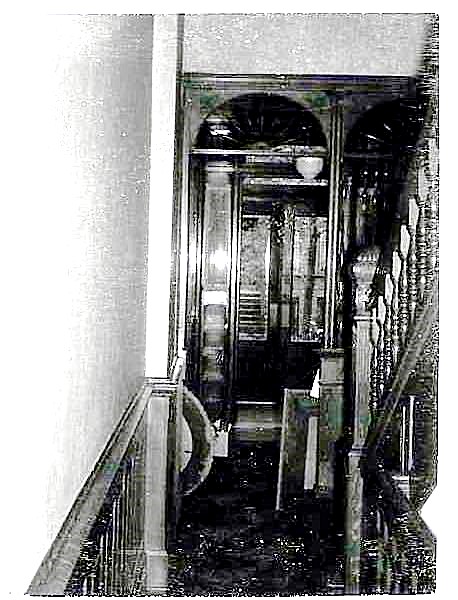
Front Hall


 Parlor


 Dining Room


Bedrooms


Kitchen


To settle Mary’s estate after her death, my father and his two sisters met at the Brooklyn brownstone and spent days sifting through multiple generations of their family history.  With several unused rooms, Virginia, Ella and Mary always had plenty of space in their home and consequently never got rid of much.  However, the home was very much outdated and in disrepair, also it was directed in Mary’s will for it to be sold by her estate.

The fact that my Dad and his sisters spent time going through the family possessions in the former home of their grandparents and spinster aunts is the primary reason that we have so many Scribner family papers and photos today.  In addition to furnishings, dinnerware and personal items, there were paintings of ships, items from Captain Scribner’s years of traveling the world, portraits of Capt Scribner’s father & stepmother, and even a painted portrait of Mrs. Scribner’s grandfather.  The three Scribner siblings sorted through family items including photos, letters, ships’ logs, and books – and each sibling took some of what was set aside to keep.

Today, 230 Garfield Place is on the tax records belonging to a single owner but declared as a 3-family home, thus it provides rental income for the owner.  The total appraised tax value of the brownstone is recorded at $4.5 million today.  Current tax rolls show that the home has 3 floors plus a full basement and totals over 4,000 sq. ft. 


The 1960 sales Offering Sheet when the home was listed for sale shows that it contained 12 ½ rooms with a bathroom only on the 2nd floor, plus an additional toilet in the basement where the kitchen, dining room and laundry were located.  Parlor rooms were on the 1st floor, and bedrooms on the top two floors. 

When the home was sold by Mary Scribner’s estate in 1960, it was in extreme disrepair.  It was appraised for the estate in 1960 at $18,500, but was sold for only $12,000 as the condition was so poor. I was told that the roof was leaking, and it was believed that no updates had ever been done on the home.

One interesting item is that the tax rolls show that the brownstone was built in 1901.  However, the 1900 Census shows the family already living at that address.  According to that census, the family owned the home with no mortgage. 

Actually, the Scribner’s appear to have purchased 230 Garfield Place in 1894.  I have an envelope & note from the USPO addressed to Mrs V A Scribner at 230 Garfield Place that is dated May 1894.  Inside was a receipt of some sort that records a legal address noted as “Old Nomenclature” (possibly where the Scribner’s lived prior to moving to 230 Garflield Place) and then a notation of a legal address noted as “New [Nomenclature]”.  That new legal address is the same as today’s legal address for 230 Garfield Place, Block 1074, Lot 14, in the Borough of Brooklyn.  The note also seems to place an 1894 assessed value on the home of $9,300, also the information on the bottom half of the note might be a value comparison to other similar homes on the block or nearby.


I believe that David and Virginia Scribner were very likely the first owners of 230 Garfield Place.

*  *  *  *  *


Key Individuals:         

     Capt David Alba Scribner  (1840 – 1911)

     Virginia Augusta Hale Scribner  (1848 – 1940)

               Henry (Harry) Dickinson Scribner  (1880 – 1943)

               Mary Islethera Scribner  (1882 – 1959)

               Ella Virginia Scribner  (1885 – 1935)


Notes:

Several years ago when my daughter was working in New York City, during one of my visits, we went to find 230 Garfield Place.  Of course, we only got to see the outside, but it looks lovely today – on a tree lined street and near parks and shopping.  I took a photo of my daughter standing on the front steps.  I wish we could have just knocked on the door and been invited in to meet my great grandparents!

- Jane Scribner McCrary

January 29, 2022

Searching Gordon with DNA

One of the most difficult lines to trace in our family history has been the Gordon line and the parents of John C Gordon who was born about 1830 in New Jersey, and died in 1886 in Brooklyn, New York.  John was the subject of my last blog post where I shared pretty much everything that we know about him – and the fact that we know nothing about his parents or early family.  

John first shows up in the 1855 Census, married to Mary Elizabeth Snedeker Gordon and with their first child.  He was a machinist, they lived in Brooklyn, and the census records show that he was born in New Jersey.  There is no mention of John’s siblings or parents in any of the family notes or research documentation that has so far been found.


The Gordon families in New Jersey seem to descend from two early immigrants who settled in the Monmouth, New Jersey area from Scotland in the late 1600’s and early 1700’s.  Most appear to descend from either Charles Gordon (1669 – 1740) or Peter Gordon (1687 – 1725).  It is suspected, but not proven, that Charles and Peter could have even been brothers or were related in some way.  And interestingly enough, our verbal family history claims that we are related to “a Peter Gordon” and that the family roots go back to Scotland.  The Charles Gordon (1669 – 1740) noted above also had a son (his eldest son) that was named Peter, so that could also confuse things for us when looking for an early Peter Gordon.

My cousin, Lynn, and I have for many years researched various Gordon family lines in New Jersey searching birth records and church records for a possible family connection to our John C Gordon.  We did find one John Gordon born in Monmouth, New Jersey in 1829 and the son of William C Gordon & Catharine Quackenbush, however he died in 1906   thus, he wasn’t our John [see the Notes at the end of the last blog post, Lived In Brooklyn but from New Jersey, for documentation].


Autosomal DNA

In recent years, we hoped that maybe DNA tests would open up some new Gordon possibilities to research and we both completed the Ancestry DNA test.  When looking at ThruLines, a DNA match feature on Ancestry, I find that there are 10 of my matches that show up as probable Gordon links.  Of those ThruLine matches, all but 1 are distant cousins that I know descend from my John C Gordon – so a DNA match to them is to be expected and doesn’t provide any new information.

Keep in mind that the ThruLines feature at Ancestry looks at the family trees that have been input by the match owners, thus the results that project the ThruLines common ancestors are totally dependent on the accuracy of the research that was used to build the family trees associated with the match owner.

The problem is that several of the Ancestry trees belonging to my known cousins that are fellow descendants of my John C Gordon incorrectly show William Crawford Gordon & Catharine Quackenbush as the parents of our John C Gordon.  Consequently, the ThruLines program erroneously projects that we all connect through William Crawford & Catharine directly to earlier generations of Gordons and Quackenbushes – a flawed assumption.  Thus the majority of the early ancestors shown in Ancestry’s ThruLines cannot be proven as our direct ancestors.

However, there is 1 of my identified Gordon DNA ThruLine matches that is not a descendant of our John C Gordon.  The link shown in the family tree for this ThruLine match is a Quackenbush link through an uncle of Catharine Quackenbush.  This is relevant because it could indicate that there “might” be a Quackenbush-Gordon connection for us that is earlier than William Crawford Gordon & Catharine Quackenbush.  Thus our John C Gordon “possibly” could have been related to either William or Catharine as a remote cousin, though not as their son.

In early times the communities were small and local families often intermarried.  It is possible that there is a common Quackenbush ancestor, a Gordon ancestor or even both that we share with this DNA match and is yet to be identified.

The bottom line is that with the autosomal DNA test through Ancestry we got little or no real information on the lineage of our John C Gordon that could help us break down our brick wall, and lots of questionable ThruLine suggestions.


Y-DNA

More recently, my cousin Lynn decided that a Y-DNA test might be more helpful to our Gordon search.  An autosomal DNA test looks at connections among all of the DNA segments, both paternal and maternal.  However, Y-DNA is inherited only in the male line, thus we were hoping to find a Gordon line that might be easier to identify if a Gordon male from among our Gordon cousins took the Y-DNA test.  There is even a Gordon DNA Project with over 1,000 participants who have taken the Y-DNA test and compared results to assist with making Gordon connections worldwide.

Lynn identified a direct-line male Gordon descendant cousin in our extended family who agreed to take the Y-DNA test, and he generously agreed to share his results with us, as well as to add them to the Gordon DNA project database.  We were so excited at the prospect of finally getting somewhere and possibly breaking down our Gordon brick wall!


Sometimes when you do research hoping to find answers, you end up with surprises and even more questions.  That is certainly what happened with our Gordon Y-DNA effort.  We ended up with about 25 Y-DNA matches, though less than half of those, or about 10, were strong enough matches to be considered relevant.

Now you would expect that the Y-DNA matches would mostly be with individuals with a Gordon surname because Y-DNA only transfers from father to sons (i.e. Gordon to Gordon to Gordon, etc) along the male line, and thus you would expect to find matches with mostly Gordon surnames.  But among the 10 strongest matches in our Gordon Y-DNA test there were only 2 Gordons – and there were 7 matches with the last name of Middleton!

A change of a surname is always a possibility in any generation.  Such exceptions are defined as “non-paternal events” and would be the likely result of an adoption, intentional name change, or the result of a liaison between a Gordon and a Middleton resulting in the child being raised with the mother’s surname.

First of all, our 2 Gordon Y-DNA matches link with the Gordons from New Jersey and confirm that we fit in with that group.  However, once again we didn’t find any Gordon lines that we could tie directly to our John C Gordon.

Several of our Middleton Y-DNA matches have worked extensively on their genealogy and documented their family trees back to the 1600’s in Scotland, likely the Aberdeenshire area, where there were both Gordons and Middletons.  However, there is no historical evidence that will document that there was a male Gordon fathered by a Middleton, or documentation that a Middleton changed his name to Gordon.  A result of the Gordon Y-DNA Project is that there is an academic consensus that our Gordon line definitely connects back to a Middleton line, probably in Scotland. 

There is some speculation that possibly Charles, the youngest son of Alexander Middleton (1610 – 1686) of Aberdeenshire, Scotland, could be the same person as Charles Gordon (1669 – 1740), who immigrated to New Jersey.  The wife of Alexander Middleton was a Gordon, and that would assume that Charles changed his surname to Gordon, his mother's maiden name, prior to his arrival in America.

This comprehensive Gordon family website https://history.wdgordon.com/gedcom/p16.htm#i480 claims that Charles Gordon (b.1664) was the son of Alexander Middleton, however no documents have been found to verify that claim.  Others believe that the event resulting in the name change could have been generations earlier.

The Gordon-Middleton link is proven by the Y-DNA results.  And, it looks like the “non-paternal event” was very likely prior to the arrivals of Peter Gordon and Charles Gordon in New Jersey in the late 1600’s.  Of course, we will probably never have answers about the “Middleton to Gordon event” – but it stands as one of the most intriguing mysteries on our family tree.

I feel that our Gordon Y-DNA results once again prove that our Gordon line connects with the New Jersey Gordon’s.  And that our earlier ancestors were indeed from Scotland, and that we likely descend from either Charles Gordon (1669 – 1740) or Peter Gordon (1687 – 1725) both of whom immigrated to the Monmouth area of New Jersey sometime around the late 1600’s. 

We are still searching for the direct line of descent for our John C Gordon.

*  *  *  *  * 

Key Individuals:

        John C Gordon  (~1830 – 1886)

        Mary Elizabeth Snedeker Gordon  (1832 – 1912)

- Jane Scribner McCrary

January 16, 2022

Lived in Brooklyn, but from New Jersey

John C Gordon, my 2nd great grandfather, was born in New Jersey around 1830.  We know that he was born in New Jersey because most of the censuses that he shows up in record New Jersey as his birthplace; also family verbal history notes that he was born in New Jersey. 

The earliest record that I have for John C Gordon is the 1855 New York Census which shows him living in Brooklyn.  By that time John was married to Mary Elizabeth Snedeker Gordon with a child, Ellen, who is eight months old.  John is noted in the census as a “market man” and I believe that indicates that he was employed in retail business.  By 1860, the couple had another daughter, and the census shows John’s occupation to be a machinist.  Subsequent censuses, and also city directories for the next 25 years, show John’s occupation as a machinist or engine builder.

In 1863, John C Gordon is in included in the Civil War Draft Register as a machinist, born in New Jersey, married and living in Brooklyn at 148 Park Avenue. Given that John was in his early 30’s at this time, it’s reasonable to wonder if he might have enlisted or been drafted to fight in the Civil War.  But we found no records that indicate that John was ever in the military.  The 1863 address for the family is very near the Brooklyn Navy Yard, making it reasonable to assume that maybe John’s machinist skills were needed at the Brooklyn Naval Yard for the Union effort.


The Gordon family grew to five children including Ella, Theresa, John Calvin, Catharine known as Katie, and Harry – all of whom lived to adulthood.  Over the next 20 years the Gordon family lived at a couple of different Brooklyn addresses, though they were all still relatively close to the same area.  Later, and not long before John’s death in 1886, John & Mary Elizabeth moved a bit further away to 23 Moffat Street, a home that they owned, also in Brooklyn.  

John’s death certificate shows him to have been a carpenter, not a machinist.  However, I suspect that in his later years, John probably did carpentry, construction or odd jobs for his son, John Calvin Gordon, who was a Brooklyn builder.  Mary Elizabeth outlived John by another 25 years.

Information in John’s obituary mentioned that he had belonged to a masonic organization.  I checked with the New York Masonic Library, and verified that he joined the Joppa No. 201 Lodge as a machinist in 1858, and was a lifetime member, likely a Master Mason.

John C Gordon, who was born about 1830 and died in 1886, is one of my most frustrating genealogy brick walls in that I have never been able to determine who his parents were or even if he had any siblings.

*  *  *  *  *


Key individuals:

     John C Gordon  (~1830 – 1886)

     Mary Elizabeth Snedeker Gordon  (1832 – 1912)

              Ella F Gordon  (1854 – 1895)

              Theresa J Gordon  (1858 – 1884)

              John Calvin Gordon  (1860 – 1945)

              Catharine/Katie L Gordon  (1863 – aft. 1942)

              Harry Gordon  (1873 – 1914)


Notes:

1)  You may have noticed that the eldest son of John C Gordon and Mary Elizabeth is John Calvin Gordon.  That makes one think that possibly John Calvin Gordon is a Jr and maybe Calvin is also the father’s middle name.  But unfortunately, we have only seen the initial C, and never Calvin, associated with the father’s name on documents.  And also along those lines, we have never seen John Calvin Gordon referred to as a Jr on any documents.

2)  Verbal family history about our Gordon ancestors are that we are related to “a Peter Gordon” and that the family roots “go back to Scotland”.

3)  There are problems with some online family trees that show the parents of our John C Gordon as William Crawford Gordon & Catharine Quackenbush of Monmouth County, New Jersey.  That assertion comes from finding an 1850 Census showing John Gordon at 18 years with parents of William C & Catharine Gordon in Monmouth County.  The assumption is then made that he is the same as our John C Gordon found 5 years later in Brooklyn at 23 years in the 1855 Census – but he isn’t.  The John Gordon found in the 1850 census with his parents, William C & Catharine Gordon, actually died in 1906 https://www.ancestry.com/imageviewer/collections/5164/images/41381_2421406274_0781-02510?treeid=&personid=&hintid=&usePUB=true&usePUBJs=true&_ga=2.86089116.563974912.1636489847-1507448262.1587330499&pId=2220671  and he is buried in the Old Tennant Churchyard in Monmouth where is parents are also buried.  He could not possibly have been our John C Gordon.

I suspect that we might be related to this line of the Gordon family – just not directly through William Crawford Gordon & Catharine Quackenbush.

4)  My cousin, Lynn, and I have worked together on our common genealogy for many years, mostly via email as we don’t live near each other.  Our John C Gordon has always been a major mystery for us and after many years, and countless hours of research, we are still unable to find any information on his birth family in New Jersey. More recently, we attempted to find some answers to our questions using DNA.  I’ll share that journey with you in my next blog post.

 – Jane Scribner McCrary

Charles Ranlett Flint (1850 - 1934)

I reluctantly ended my blog over a year ago because I felt that I had run out of stories to tell.   However, I said that I might occasionall...