April 30, 2022

Ancestors Who Fought in the Revolution – part 3

This is the last of three blog posts about my direct ancestors that were involved in service during the Revolutionary War.  These two direct ancestors noted below lived in the Baltimore and Harford areas of Maryland.

Aquila Hall (1750-1815), a 4th great grandfather

Walter Tolley (~1715-1783), a 5th great grandfather


Aquila Hall (1750-1815)  Colonel Aquila Hall (also known as Aquila Hall Jr to distinguish him from an older uncle also named Aquila Hall) was born in Harford County, Maryland to a wealthy landholding family.  Aquila was directly descended from John Hall who was transported from England to Maryland in 1640 [see the January 2021 blog post, Legacy of Enslavement].

Aquila was well educated and became a lawyer in 1774 just as the Revolution was gaining ground.  Early in 1775, Aquila was appointed to a special committee that drew up and signed a document known as the Bush River Declaration [see the blog post, Path to Independence, published on my blog in July 2020].   This document is made up of resolutions that advocated more self-government for the Colonies, and it is historically regarded as an important step in the movement towards Independence.

Before year end, Aquila was authorized to purchase 20 half-barrels of gunpowder and 4,000 weights of lead for the local militia.  In December 1775, he married Ann Tolley of Baltimore.  Aquila and Ann had a dozen children, though 2 died in infancy.

Soon after his marriage, in January of 1776, Aquila was appointed Colonel of the Upper Battalion of the Harford County Militia.  At one point General Washington was entertained by him and his staff at Aquila’s home in Havre de Grace, which later resulted in the British burning Aquila’s home in retaliation.  I’m not sure if he ever engaged in battle, or simply served in the planning and operations activities for the Baltimore Continental militia.

During much of Aquila Hall’s lifetime, he and Ann lived at their home estate known as Long Green in Baltimore County.  He died at Long Green in 1815 at the age of 65.


Walter Tolley (~1715-1783) was also born and raised in Baltimore County, Maryland.  He was the father of Ann Tolley and the father-in-law of Aquila Hall noted above.  I’m not sure how he was involved with the Revolution but he shows up in a source titled the “Abstract of Graves of Revolutionary Patriots”.

Walter was a large land owner and planter.  He served in the Lower House of the Legislature in Baltimore County in 1751 and as a tobacco inspector between 1754-1757.  Walter Tolley also served as a captain in the local Baltimore County militia in 1756 though he was already in his 60’s by the time of the Revolution.  I have no doubt that he did his part to support Colonial efforts seeking Independence and to be counted as a Revolutionary Patriot.

Walter Tolley first married Marry Garrettson in 1735, and after her death he married Martha Hall in 1751.  Martha Hall was also a great granddaughter of the 1640 immigrant, John Hall from whom Aquila Hall was descended.  Walter’s daughter, Ann Tolley, who married Aquila Hall was a child of his second marriage.  Walter died at the age of 69 in 1783 in Baltimore County, Maryland.  At his death he owned about 3,000 acres in Baltimore and Harford Counties.

*  *  *  *  *

Notes: 

If you are interested in the supporting documentation sources available for any of the individuals and their Revolutionary service, please don’t hesitate to contact me, and I will be happy to share.

- Jane Scribner McCrary

April 10, 2022

Ancestors Who Fought in the Revolution – part 2

This next blog post includes short biographies about the Revolutionary service of several of my direct ancestors from New London, Connecticut, where many of my ancestors were born.

James Smith, Jr (1732-1798), a 5th great grandfather

John Rogers (1760-1796), a 4th great grandfather

Nathaniel Dickinson (1749-1797), a 4th great grandfather

James Smith, Jr (1732-1798) James Smith Jr was born in New London, Connecticut in 1732.  James was referred to in the Joshua Hempstead Diary as “James Smith Son of James Smith the Barber”.  His father was paralyzed and lost the use of his limbs when James was a child and he lived for about 20 years so afflicted.  Consequently James grew up very poor suffering hard times even though the community did what they could to help the family.

James Jr married Abigail Hempstead, also of New London in 1756 and they remained in New London near their families. They had 7 children, and at least 4 of them lived to adulthood.  In 1775, and prior to the birth of their last child, James enlisted under Capt James Chapman of New London in the 6th Regiment commanded by Col Samuel Holden Parsons and was involved in the defense of Boston.  James also served as a sergeant in 1782 in Capt Deshon’s company called the First Alarm List by the order of Col Jonathan Latimer.

James Smith, the son, died in 1798 in New London at 66 years of age; and his wife, Abigail, lived another 16 years.


John Rogers (1760-1796), also a New London native, enlisted in Col Sheldon’s 2nd Regiment Light Dragoons Continental Troop commanded by Col Elisha Sheldon in 1777 while quite young at only 17 years old.  He served with the troop through 1779 and was noted as a Private and also as a seaman in the military records. 

In 1782, John Rogers married Hannah Smith, a daughter of James Smith Jr and Abigail Hempstead noted above, and spent his adult life on the sea.  Captain John Rogers was a master mariner and often sailed routes from New London to the East Indies.  In 1796, when he was only 36 years of age, Capt John Rogers sailed from New London, in a vessel that he owned, heading for Barbados.  Accountings are that the ship went down at sea and he was drowned in sight of New York Harbor.  Capt John Rogers left behind a pregnant wife and at least 5 young children when he was lost at sea.  Hannah Smith Rogers, John’s wife, lived many more years until she died in 1845 in New London at the age of 83.


Nathaniel Dickinson (1749-1797)  Our family has several ancestors from the New London, Connecticut area, and another who was involved in the Revolution effort was Nathaniel Dickinson.  He was a seaman and mariner living and working out of the port or New London.  While there are no military records of Nathaniel’s involvement, according to family letters Nathaniel was involved in the defense of New London in 1781 when British forces attacked the port of New London and Fort Griswold in Groton in an attempt to divert General George Washington from his efforts in Virginia.  Known as the Battle of Groton Heights, many ships and buildings in both New London and Groton were burned and casualties and losses were suffered by both sides.  

Nathaniel’s greatest contribution to the War of the Revolution was as a privateer on armed vessels that worked to disrupt British trade and commerce. He often served aboard ships as the Prize Master, and assumed responsibility for the cargo and as the Captain of captured vessels that were then sailed into port to be turned over to the United States authorities.  You can read a more complete accounting of the life of Nathaniel in my blog post, Aboard a Prison Ship in the Revolution, posted in July 2020.

In June 1782, Nathaniel was aboard the armed privateer vessel named the Lively that was captured by the British.  He was wounded and taken prisoner and subsequently confined aboard the Jersey Prison Ship anchored in New York Harbor.  By the time his family could get enough money to exchange Nathaniel (the British demanded payment for his release) he was very sick and emaciated from the months of harsh and close confinement.

Nathaniel eventually resumed his mariner life, though his experience aboard the British prison ship left him with compromised health for the remainder of his years.  Nathaniel died of illness while at sea in early 1797 at 48 years of age.  Among the list of items recorded in Nathaniel Dickinson’s estate inventory, and valued at three-dollars, was a “Picture of General Washington on horseback” – a reminder of the struggles and accomplishments of the Revolution.


The last of these blog posts will take us south to Maryland to find a couple of more Revolutionary Patriots.

*  *  *  *  *

Notes:

If you are interested in any of the supporting documentation sources used for any of the individuals and their Revolutionary service, please don’t hesitate to contact me and I will be happy to share.

- Jane Scribner McCrary

March 17, 2022

Ancestors Who Fought in the Revolution – part 1

I thought that members of my family might be interested hearing about some of our ancestors that have been documented as having been involved in the Revolutionary War.  All of the ones that I know about are on the New England branches of my father’s family and have been pretty well documented.  So far, I have found nine direct ancestors along three branches of our family tree that fought in the Revolution.  These gentlemen range from a 3rd great grandfather to a couple of 5th great grandfathers.

In this series of three blog posts, I am planning to include short biographies about the Revolutionary service for these direct ancestors:

Abraham Howland (1762-1853), a 3rd great grandfather

Samuel Scribner (1735-1815), a 4th great grandfather

Stephen Staples (1739-1798), a 4th great grandfather

Joseph Ricker, Jr (1746-1825), a 4th great grandfather


James Smith, Jr (1732-1798), a 5th great grandfather

John Rogers (1760-1796), a 4th great grandfather

Nathaniel Dickinson (1749-1797), a 4th great grandfather


Aquila Hall (1750-1815), a 4th great grandfather

Walter Tolley (~1715-1783), a 5th great grandfather


While there are no names of any female ancestors on the above list, the women, mothers and wives and families of these ancestors were involved in ways that supported the efforts of their men and the Revolution as they struggled for Independence from Britain.

This first blog post will begin with my direct ancestors that lived in Massachusetts and Maine.  Maine was a part of the Commonwealth of Massachusetts until 1820.  Most of the place names noted below were a part of the Commonwealth of Massachusetts at the time of the Revolution, though now many are located in Maine.


Abraham Howland (1762-1853) was a direct descendent of John Howland & Elizabeth Tilley, both passengers on the Mayflower and mentioned in a few of my earlier blog posts.  Abraham was also a descendant of one of John Howland’s brothers, Henry Howland, who arrived several years after the Mayflower.  Abraham’s mother was a direct descendent of John Howland, and his father was a direct descendant of Henry Howland, John’s younger brother.

Abraham was born in Pembroke and moved when he was 5 years old with his family to Topsham in the Commonwealth of Massachusetts.  When he was only 16 years old he joined a Revolutionary militia in Topsham.  Abraham served in 1779 as a Private with Capt Aster Patten and under Col Samuel McCobb and participated in a mission afterwards known at the Penobscot Expedition.  The troops traveled to Bagaduce on the Penobscot Bay where they attacked the British troops and proceeded to Cox’s Head on the Kennebec River where he assisted with the building of a fort.  At the expiration of his service he returned home to Topsham.  Abraham’s service was documented and he was granted a pension at the end of the War. 

In 1787 Abraham married Anna Staples in Topsham where they lived and raised at least 12 children that lived to adulthood.  Abraham’s father-in-law, Stephen Staples also fought in the Revolution.


Stephen Staples (1739-1798) was born and raised in the town of Falmouth, Massachusetts.  He married Judeth Morrill in Topsham in 1760 and they had 2 children before Judeth died.  He then married Susannah Hobbs in 1764 and they had 9 more children including a daughter, Anna, through which my line descends.

Records indicate that Stephen Staples joined the Continental Army on or before 1777.  He served in regiments with Capt Lane’s Company, Col Ichabod Alden’s 6th regiment, and Capt Daniel Lane’s Company.  He was included on muster rolls at Cherry Valley in 1778 and also with Capt Asa Coburn’s Light Infantry Company in 1779 at Fort Harkimer.  The Continental Army pay accounts for the service of Stephen Staples date through 1780. 

Stephen died in 1798 at Topsham, Massachusetts.  Five years after Stephen’s death, Susannah Hobbs Howland married again, but had no more children.  She died in 1824 in Topsham, Maine.


Samuel Scribner (1735-1815) was born in Exeter, New Hampshire and was a resident of Massabesic. He married Sarah Bucknell in 1764 in Somersworth, New Hampshire and they settled in York County, Massachusetts.  Their family eventually grew to 10 children of which 6 reached adulthood. 

When Samuel was about 40 years old, he enlisted in July 1775 at Hollis, Massachusetts, and he served 8 months in the Revolutionary War with the Massabesic Militia Company.  Later, in 1778, he served with the 3rd York County Regiment in Capt John Smith’s Company.  He also appears in Revolutionary War pay documents in August 1778 as a Private in Capt Ebenezer Webster’s Company, Col Nichol’s Regiment, Gen Whipple’s Brigade of the New Hampshire Volunteers who participated in the Expedition to Rhode Island.  According to a letter written by Samuel’s grandson, “he [Samuel] saw hard service in that war [Revolution] and was a noble soldier.”

Samuel Scribner had a distinguished life, and I plan to write a blog post about him and his endeavors at a later time.  He died in 1815 on his farm in Waterborough, York County, Massachusetts at 80 years of age.


Joseph Ricker, Jr (1746-1825) was born in Berwick, York County near the New Hampshire border.  Joseph Ricker Jr’s grandfather, Maturin Ricker, was born in St Brelade, Isle of Jersey, one of the Channel Islands in England.  He came from England to America with his brother in 1670 and was an early settler in New Hampshire.  Both brothers were killed by an Abenaki Indian raiding party in 1706 while working in the fields.  Maturin’s youngest son was carried away by the Indians but his wife, Rebecca Shaw Ricker, and another son, Joseph, survived to raise his family in the territory.

Before the Revolution began, in 1767, Joseph Ricker Jr married Deborah Wentworth in York County, Massachusetts where they raised a family spanning the time before, during and after the Revolution and had at least 7 children that survived into adulthood.

Joseph Ricker Jr was commissioned in 1776 as a First Lieutenant with Capt Samuel Grant’s 3rd Berwick Company; and he also served as a captain with Col J Godwin’s 2nd York G Company, 6th Regiment in 1780.   


My next blog post will focus on several of my direct descendants from the New London area in Connecticut that participated in the Colonial campaign for Independence.

*  *  *  *  *

Notes:

If you are interested in any of the supporting documentation sources used for any of the individuals and their Revolutionary service, please don’t hesitate to contact me and I will be happy to share.

- Jane Scribner McCrary

February 28, 2022

Artifacts of Mariner Life

I have already written several blog posts on the life of Captain David Alba Scribner, and in this one I decided to include just a few things that remain in the family from his seafaring life.  Because his grandchildren were able to clear his home after the death of his last daughter [see my last post, A Brooklyn Brownstone], many things have stayed in the family, mostly now in the possession of David’s great grandchildren or even great great grandchildren.  There are several artifacts related to Captain Scribner’s life at sea that are interesting, so I thought I would share a few.

Some of the Scribner items were things that were quite necessary to have aboard ship.  Captain Scribner kept his ship’s sextant, telescope and barometer that were critical tools for any mariner captain.


The small medicine box accompanied Captain Scribner on all his voyages.  I would have expected that there might have also been a medical book among his possessions.  The label inside the top cover of the medicine box notes it as a “Homeopathic Pharmacy” assembled by a business in San Francisco. I would expect the pharmacy was also where the vials could be refilled as needed.  Just for fun, I looked up the first item that was listed, Aconitum, and discovered that it is highly poisonous; however it was also once used to reduce fever and to slow the heart rate for sedation.


There were at least three sea chests that were kept in the Scribner family.  Often the captain’s cabin would have the luxury of some built-in cabinets and drawers enabling many items to be safely stored during rough seas while the chests and trunks were often stored below in the hold during the voyage.  I expect that the small chest shown with the brass inlay held clothing and personal items and the other trunk shown probably contained household items for the voyage, as it is quite large. 

I remember the larger trunk many years ago when it was all scuffed up and had pink or green vinyl contact paper adhered to it.  One of the rope handles was missing.  My mother lovingly refinished the trunk and had another rope ring made to replace the missing one.  She also refinished the small trunk and had some of the missing brass inlay replaced on it.  We now know that refinishing the trunks considerably reduced their antique value; however it did result in furniture pieces that could be used and enjoyed for many more years.

There were several paintings of ships in the Scribner home at 230 Garfield Place in Brooklyn that were sailed by Captain Scribner during his mariner career including the paintings below of the St Francis, St David, and Henry B Hyde.  Each of the three grandchildren kept one of these paintings in their family.


And there were a few ships’ logs, including a personal log written by Virginia Scribner, and a photo album that remained with Captain Scribner and his family.  Unfortunately, many of the photos in the album were not labeled and only a few could be identified from other known family photos.  The logbooks were kept by the families of the Scribner grandchildren, though I know that several are now in the G W Blunt White Library manuscript collection at The Museum of America and the Sea located in Mystic, Connecticut.


This interesting wooden model of a ship was among Captain Scribner’s prized possessions.  Unfortunately, it is not labeled or signed.  Wood carving and making ship models was a favorite pastime and hobby for seamen during slack times while at sea. 

Its possible Capt Scribner’s ship model could have been made by a friend or fellow crewman.  However, I believe that it could also have been made for him by someone at Sailors Snug Harbor.  Around 1900, when David Scribner retired from the sea, he became a Trustee of Sailors Snug Harbor, where he also served an Acting Governor of the Harbor in the Governor’s absence. 

Sailors Snug Harbor is located on Staten Island, New York.  The facility opened in 1833 as the first maritime home and hospital for retired seamen in America with generous funds provided in the will of Robert Richard Randall.  The seamen were provided a home, food and healthcare in the company of other retired seafarers.  In 1900, when Capt Scribner was involved, there were over 1,000 former seamen living at the home.  The large property included farms, a dairy, a bakery, workshops, a chapel, sanatorium, hospital, cemetery, dormitories and recreational areas and gardens.

Around the mid-1900’s the endowment funds began to run out and programs like Social Security and Medicare reduced the demand for care.  The site was purchased by the City of New York and is now known as the Snug Harbor Cultural Center & Botanical Garden.

The death certificate for David A Scribner actually notes that his place of death was at Sailors Snug Harbor on the afternoon of February 7, 1911.  He died from a cerebral hemorrhage or stroke.

*  *  *  *  *

Key Individuals:

       David Alba Scribner  (1840 – 1911)

       Virginia Augusta Hale Scribner  (1848 – 1940)

Notes:

I have found it mentioned in two different books that macramé was one of Capt Scribner's pastime hobbies while at sea.  It would be nice to see some of the macramé items that were created by him, but I am not aware of any that might still exist. 

"... captains especially had many lonely hours.  To while them away many often developed hobbies ... Captain David A. Scribner's specialty was macramé lace." 

Source:  Songs of American Sailormen, by Joanna C Colcord; Norton & Co.; New York; 1938 – and also cited in The Maritime History of Maine Three Centuries of Shipbuilding & Seafaring; by William Hutchinson Rowe; W W Norton & Company, Inc; New York; 1948; page 226.

Also in the sea journal of his wife, Virginia [see the blog post dated July 16, 2021, Virginia’s Sea Journal], she sometimes mentioned that David would make toys for the children or small items for their living space.  In one entry she wrote “Dave made a pretty bracket to put in the corner and another one for our soap dish.”

- Jane Scribner McCrary
February 16, 2022

A Brooklyn Brownstone

In the 1890’s, my great grandparents, Captain David Alba Scribner and his wife Virginia Augusta Hale Scribner, purchased a home in Brooklyn, New York.  Their 4-floor brownstone home was located at 230 Garfield Place in the Park Slope neighborhood near Prospect Park in Brooklyn. 

The Brooklyn brownstone was the Scribner family home from the mid-1890’s until 1960.  After the 1911 death of Captain Scribner, his wife, Virginia, and two daughters remained in the home until their deaths.  David & Virginia’s son, Harry, had moved out of the brownstone in 1912 when he married.  Neither of their daughters ever married, however, and they remained in the home until their deaths.  Ella was a school teacher and she died in 1935 at 50 years of age.  Mrs Scribner died next in 1940 when she was 91 years old.  And the last daughter, Mary Islethera Scribner, remained in the brownstone until her death in 1959 at 76 years of age. 


 My father remembers the Brooklyn brownstone home of his grandparents – saying that “it was a fun house to visit because it had a dumbwaiter going from the kitchen up to the bedrooms that we used to ride, and then jump up on my grandmother’s feather down mattress bed that was huge.” That bed was so tall that there were steps on the side for use to get up onto the bed.  I now have the antique quilt that was on that bed, and it covers an entire king-sized bed and drapes nicely on all sides.

The Scribner family quilt used in the home at 230 Garfield Place


By the time that Mary died, she had been living on the lower floors of the brownstone – having not needed to use of the top floor for many years.  The home was like a time capsule with all of the furnishings and personal belongings dating back many decades to the married life of Capt. David A Scribner and his wife, Virginia. 


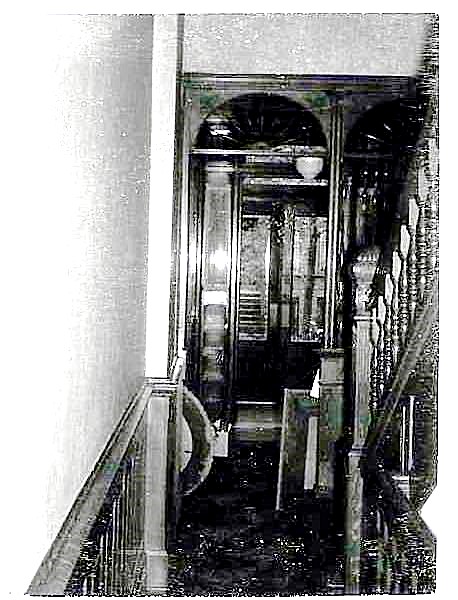
Front Hall


 Parlor


 Dining Room


Bedrooms


Kitchen


To settle Mary’s estate after her death, my father and his two sisters met at the Brooklyn brownstone and spent days sifting through multiple generations of their family history.  With several unused rooms, Virginia, Ella and Mary always had plenty of space in their home and consequently never got rid of much.  However, the home was very much outdated and in disrepair, also it was directed in Mary’s will for it to be sold by her estate.

The fact that my Dad and his sisters spent time going through the family possessions in the former home of their grandparents and spinster aunts is the primary reason that we have so many Scribner family papers and photos today.  In addition to furnishings, dinnerware and personal items, there were paintings of ships, items from Captain Scribner’s years of traveling the world, portraits of Capt Scribner’s father & stepmother, and even a painted portrait of Mrs. Scribner’s grandfather.  The three Scribner siblings sorted through family items including photos, letters, ships’ logs, and books – and each sibling took some of what was set aside to keep.

Today, 230 Garfield Place is on the tax records belonging to a single owner but declared as a 3-family home, thus it provides rental income for the owner.  The total appraised tax value of the brownstone is recorded at $4.5 million today.  Current tax rolls show that the home has 3 floors plus a full basement and totals over 4,000 sq. ft. 


The 1960 sales Offering Sheet when the home was listed for sale shows that it contained 12 ½ rooms with a bathroom only on the 2nd floor, plus an additional toilet in the basement where the kitchen, dining room and laundry were located.  Parlor rooms were on the 1st floor, and bedrooms on the top two floors. 

When the home was sold by Mary Scribner’s estate in 1960, it was in extreme disrepair.  It was appraised for the estate in 1960 at $18,500, but was sold for only $12,000 as the condition was so poor. I was told that the roof was leaking, and it was believed that no updates had ever been done on the home.

One interesting item is that the tax rolls show that the brownstone was built in 1901.  However, the 1900 Census shows the family already living at that address.  According to that census, the family owned the home with no mortgage. 

Actually, the Scribner’s appear to have purchased 230 Garfield Place in 1894.  I have an envelope & note from the USPO addressed to Mrs V A Scribner at 230 Garfield Place that is dated May 1894.  Inside was a receipt of some sort that records a legal address noted as “Old Nomenclature” (possibly where the Scribner’s lived prior to moving to 230 Garflield Place) and then a notation of a legal address noted as “New [Nomenclature]”.  That new legal address is the same as today’s legal address for 230 Garfield Place, Block 1074, Lot 14, in the Borough of Brooklyn.  The note also seems to place an 1894 assessed value on the home of $9,300, also the information on the bottom half of the note might be a value comparison to other similar homes on the block or nearby.


I believe that David and Virginia Scribner were very likely the first owners of 230 Garfield Place.

*  *  *  *  *


Key Individuals:         

     Capt David Alba Scribner  (1840 – 1911)

     Virginia Augusta Hale Scribner  (1848 – 1940)

               Henry (Harry) Dickinson Scribner  (1880 – 1943)

               Mary Islethera Scribner  (1882 – 1959)

               Ella Virginia Scribner  (1885 – 1935)


Notes:

Several years ago when my daughter was working in New York City, during one of my visits, we went to find 230 Garfield Place.  Of course, we only got to see the outside, but it looks lovely today – on a tree lined street and near parks and shopping.  I took a photo of my daughter standing on the front steps.  I wish we could have just knocked on the door and been invited in to meet my great grandparents!

- Jane Scribner McCrary

Charles Ranlett Flint (1850 - 1934)

I reluctantly ended my blog over a year ago because I felt that I had run out of stories to tell.   However, I said that I might occasionall...