October 17, 2020

A Career Aboard the Midas of Baltimore

My lineage has its share of sea captains including my 3rd great grandfather, David Bill Dickinson.  Born in New London, Connecticut in 1787, David was the son of  Nathaniel Dickinson, another seaman and mariner, though David’s father died when he was only 10 years old.  

By 1801, David Bill Dickinson was only 13 and already listed in the Seamen’s Protection Certificate Register for the port of New London.  He was working aboard sloops and ships that sailed out of the New London port from a young age, likely to help support his widowed mother and sisters.

Not long after the Revolution, the War of 1812 found the United States once again in conflict with the English.  Congress authorized letters of marque which commissioned private vessels, known as privateers, to attack and seize enemy vessels including British merchant ships.  The privateers were required to keep journals of their encounters, and to keep logs of any cargo that was seized.  Captured seamen were either put ashore in port or put aboard a vessel that was released.  When possible, the privateers were to deliver the captured cargo, including the actual ships seized, to naval authorities in various ports.  The privateer ship’s owners and crew would subsequently receive a percentage of the seized goods when sold.

David’s father, Nathaniel, had sailed with privateers during the Revolution, and David himself was aboard several United States commissioned privateer vessels from the early years of the War of 1812 including the Sloop Juno of New London.  In July 1812, the privateer letter of marque for the Sloop Juno records David as a Lieutenant under Captain John Howard.  And later in 1814, he was aboard the Row Galley that was part of the Torpedo Expedition off the harbor of New London.

The Midas of Baltimore was a schooner built in Baltimore in 1813.   The ship began sailing as an American merchant vessel and also a privateer during the War years often on a route between the Chesapeake, the West Indies and France.  The Midas was armed with four six-pound cannons, four six-pound carronades and 35 crewmembers.  The captain was Commander Alexander Thompson who was also a partial owner of the ship.   David joined the Midas in 1814 as the 2nd Officer; and by June that year, David was noted in the ship’s journal as the 1st Officer.


After a successful trading and privateering voyage from Chesapeake to Havana, France and Spain, the Midas returned and sailed the Atlantic seaboard where they added four more six-pound carronades and additional crew.  At that time, the British were blockading American ports to hamper American merchant business.  In 1814, the Midas had many successful encounters with British vessels in the waters of the eastern coast and the West Indies.  The Midas captured over a dozen British ships that year.

By August of 1814, the British had attacked and burned Washington, and turned north towards Baltimore.  The Midas of Baltimore was in The Bahamas where on September 13th Captain Thompson authorized a raid – led by David – on Harbour Island in retaliation for the British burning of Washington.

With the raid on Harbour Island in The Bahamas, the Midas had violated the rules of conduct for privateers issued by the State Department.  President James Madison ordered a commission to look into the incident.  Captain Thompson took full responsibility for the action, even noting in his journal that David was involved under his direct orders.  As a result, the privateer ship’s letter of marque was revoked.

In December of 1814, the owners of the Midas proceeded to remove Captain Thompson from command, loaded the ship with a cargo of flour for the West Indies, and placed the ship under the command of David whom it was noted was a “prudent man”.  The owners applied for a new privateer commission, though the War of 1812 was soon over.  And with the end of the conflict, the Midas of Baltimore was once again a merchant vessel.

Captain David Bill Dickinson sailed as the commander of the Midas of Baltimore for the next several decades until the late 1830’s.   The ship’s voyages were typically routes through the Atlantic or the Caribbean to ports in the West Indies, St Bart and Havana, Havre and Marseilles in France, Gibraltar south of Spain, and often to Smyrna, now known as Turkey. 

David was married to Mary Rogers of New London, Connecticut in 1812, and they had one daughter, Mary Ann Brown Dickinson born in 1816.  Baltimore was always the home port for the Midas, however I believe that David’s family remained in New London, Connecticut until around 1819 and the death of David’s mother.  After that time, the Dickinson family made their home in Baltimore, Maryland.  David died in 1846 in Baltimore at 58 years of age.  His widow, Mary, lived many more years after his death.

"New London County, Mystic, CT.  Mrs. Mary Dickinson, whose death we chronicle at the ripe age of 84 years, at her daughter's Mrs. Hale, was one of our most aged citizens.  Her husband, Capt David B Dickinson, was a native of New London, and a shipmaster.  He was a bold privateersman during the war of 1812, having been one of those daring young men that was constantly organizing and successfully executing plans to annoy, elude, and drive the British fleet from our waters.  Later in life he removed to Baltimore and was a well known master of that port.  He died about eighteen years ago [sic].  His widow, whose decease we notice, was also a native of New London where her remains have just been interred, and by whose side her husband's remains are to repose, as they are soon to be removed from Baltimore to rest with his relatives and early companions of the sec. in Cedar Grove Cemetery.  Mrs. Dickinson's maiden name was Rogers, an elder sister of Mrs. Charles Mallory, and Capt Henry Rogers of Mystic Bridge." – June 1875

*  *  *  *  * 

Key individuals:

     Nathaniel Dickinson  (1749 – 1797)

     David Bill Dickinson  (1787 – 1846)

     Mary B Rogers  (1790 – 1875)

     Mary Ann Brown Rogers Dickinson  (1816 – 1880)


Notes:

David Bill Dickinson appears in the London, England Grand Lodge Freemason membership registers in 1811.  He was a member of the London Naval Tavern Mason’s Lodge and is noted as a “Captain” in the log.  It appears that in 1816, David transferred his Freemason membership to Baltimore where he became a member of the Washington Lodge of Freemasons until 1828.  This Mason lodge was mostly made up of individuals involved in building and sailing ships and was located near the Baltimore dockyards.

 – Jane Scribner McCrary

October 3, 2020

A Mayflower Connection, or not …

For many years, I was fairly certain that we had a Mayflower ancestor in the family, actually two of them – John Howland & Elizabeth Tilley who both arrived on the Mayflower in 1620 as young adults, and then later married.  My 2nd great grandparents, Islethera Howland & David Scribner were married in 1821 in Topsham, Maine.  And I felt certain that Islethera Howland’s family, an old New England line, was our Mayflower connection. 

When I originally researched Islethera Howland’s family, I found that her line appeared to go back to Henry Howland who arrived in the Plymouth Colony just a few years after the Mayflower arrived.  Henry wasn’t a Mayflower passenger, however, his older brother, John Howland, was aboard the Mayflower in 1620 – a close relationship, but not a direct descendant line to a Mayflower passenger. 

   Henry Howland (1604-1671) [bro. of John Howland of the Mayflower]

      Samuel Howland (~1648-1716) m. Mary Sampson

         Abraham Howland (1675-1747) m. Ann Rouse

            Benjamin Howland (1724-1755) m. Experience Edgerton

               Abraham Howland (1762-1853) m. Anna Staples

                  Islethera Howland (1802-1843) m. David Scribner

Later in my research, I found an alternate path that took me back directly to John Howland & Elizabeth Tilley.  There were a lot of intermarriages, and also large families in those times, so a number of links are always a possibility.  This Howland line seemed pretty strong to me as I found documentation in several early published family genealogies.  And interestingly, it once again connects to my 2nd great grandmother, Islethera Howland Scribner. 

   John Howland (1592-1672) m. Elizabeth Tilley (1607-1687) 

      John Howland (1627-1702) m. Mary Lee

         Experience Howland (1668-1728) m. James Bearse/Bierse

            Experience Bearse (1692-1735) m. Dennis Edgerton

               Experience Edgerton (1725-?) m. Benjamin Howland

                  Abraham Howland (1762-1853) m. Anna Staples

                     Islethera Howland (1802-1843) m. David Scribner

For decades I believed that we were connected to the Plymouth colonists as descendants of John Howland & Elizabeth Tilley.  In more recent years, there has been extensive research done on the Mayflower passengers and their descendants. And presently, the General Society of Mayflower Descendants lineage group seems to be regarded as the best authority on the descendant lines.

Now I have never been interested in joining a Mayflower descendant’s lineage society, or any other lineage society.  For that matter, joining groups in general has never really been my thing.  But, I did feel confident that if I wanted to join the General Society of Mayflower Descendants, that I could probably do so. 

The application process requires a lot of paperwork and documentation proving direct ancestry; so you have to get together a lot of birth, marriage and death certificates for many generations along with relevant research.  An applicant submits their case along with supporting documentation, and it is reviewed for acceptance or declination which includes a process of comparing the earlier generations to known lines that the Society accepts as “proven”.  The earliest generations have already been reviewed in historical documents and early lineage books which have been determined as either good or questionable sources.

That takes me to a posting that I found online that was added to an Ancestry.com tree in 2008.  It is a response that was posted regarding someone’s application to the General Society of Mayflower Descendants.  It reads:

31 Aug 2007 - We are delighted to learn of your interest in the Mayflower Society. We have received your Preliminary Review Form and have attempted to determine a best approved lineage paper that we might have which follows your stated lineage. Unfortunately, it has never been proved that John and Mary (Lee) Howland's daughter/son Experience married James Bearce, and the Mayflower Society does not accept this line as a Mayflower lineage. As found in "John Howland of the Mayflower" Volume 2, on the Descendants of John2 Howland: "There is no proof that Experience married James Bearce of Barnstable, who moved to Halifax, Mass. Experience was considered a man until 1930 when the Bearse Genealogy suggested that this Experience might have been a woman who could then have married James Bearse. No proof has been found for such a marriage." So, I'm sorry, but you have no accepted Mayflower lineage here.

   Regards, Paul S Bumpus Librarian, General Society of Mayflower Descendants GSMD.

Well, this shoots down what I thought was the link that I had to a Mayflower line of descent.  I had connected our line with Experience Bearse, the daughter of Experience Howland & James Bearse in my chain of descent. 

Oh, but wait!  In writing this story, I thought I might check and see if any more research had turned up, and it has.  Only a few months ago in April 2020, it was posted that the General Society of Mayflower Descendants now accepts that James Bearse/Bierce did marry Experience Howland.  I found the following online:

“The Mayflower Society did recently discover evidence that proves that Experience Howland (granddaughter of Mayflower passenger John Howland) married James Bierce. We are currently accepting applications that go through this couple. Currently we have approved applications going through these 4 different children of Experience Howland and James Bierce: 1) James, 2) Priscilla, 3) Rebecca, and 4) Shubael.” – Mayflower Lineage Match, April 30, 2020, Erin Gillett, Research Assistant, General Society of Mayflower Descendants GSMD.

I’m getting closer now with “official acceptance” that Experience Howland (a Mayflower descendant) married James Bearse.  That helps – except that my family line is through a daughter, Experience Bearse, and she isn’t listed as one of the 4 children noted above for which they have already approved applications.  My research sources indicate that James & Experience had at least 8 children, so it might be just a matter of time before the Society receives an application descending through Experience Bearse, daughter of James Bearse & Experience Howland, and expands their acceptance criteria.

However, if you are connected to my family line, and want to apply to a Mayflower lineage society, be prepared for the possibility of this hang-up.

*  *  *  *  *

Key individuals:

   Henry Howland  (1604 – 1671)

   John (the Mayflower) Howland  (1592 – 1672)

   Elizabeth Tilley Howland  (1607 – 1687)

   Abraham Howland  (1762 – 1853)

   Islethera Howland Scribner  (1802 – 1843)

 – Jane Scribner McCrary

September 21, 2020

Henry Hale Unsolved

Henry Hale is one of my ancestors that I know almost nothing about.  He is one of my 3rd great grandfathers and he first appears when he married, Martha Susannah Hall (known as Susan Hall) in September of 1800 in Baltimore County, Maryland.

“On Thursday evening last, the 11th instant, was married, by the Reverend Mr. Wilmer, captain Hale, to miss Susan Hol, daughter of Aquila Hall, esquire, at his seat on Long-Green, Baltimore county.”

I have not been able to find anything about Henry or his family that I can definitely tie to him before his 1800 marriage.  I believe that it is probable that Henry was from the Baltimore area or they might have made note of where he was from in the wedding announcement.  Also, a couple of census records for his children indicate that their father, Henry, was born in Maryland. 

Henry Hale died in 1841.  The probate paperwork for his estate leaves everything to his wife, Susan, but the inventory contains only household possessions, farm equipment and animals – no property or residence. This isn’t surprising as Henry & Susan lived on property in Baltimore County that Susan’s father had granted to them for their life in his 1815 will.  Henry Hale’s will seems to indicate that he did not have any other land or property at the time of his death. 

Another problem is confusion over what year Henry Hale was born.  One family history document written in 1897 says Henry was born in 1782, however that would make him only 18 years old when he married, almost five years younger than Susan, and already a Captain – all highly unlikely in my opinion.  Henry’s gravestone in Fork United Methodist Cemetery is inscribed “Capt. Henry Hale, born Oct 11th 1755? died May 11th 1841” – however that headstone is very difficult to read, especially the birth year.  And the last source is Henry’s obituary found in a Baltimore newspaper, noting that he was 67 years of age at his death in May of 1841 – which means he was born in 1773 as he died before his October birthday that year. 

I actually believe that the birth year of 1773 taken from Henry Hale’s obituary might be the correct date, probably making his birth date as October 11, 1773.  If born in 1773, Henry would have been 27 and Susan 22 years when they married.

One reason I strongly believe that Henry was born in 1773 instead of 1755 are the 1810 - 1840 census records.  These census records are for the time after Henry’s marriage and before he died, and in these years individuals and their ages aren’t listed by name but simply tabulated by number in groups.  All four of these years’ census records show Henry Hale as the head of household and individuals are grouped by age and gender.  For example, the 1810 census shows Free White Males under 10 yrs: 4 (which would be Henry & Susan’s oldest 4 sons), and Free White Males 26-44 yrs: 1 (Henry at 37 years, if born in 1773).  In all four censuses there is 1 Male noted in the correct age category if Henry had been born in 1773.  Also in all of these censuses, no male is recorded in any older age category, as should have happened if Henry had been born in 1755.

The wedding notice, his obituary, and his gravestone all title Henry as “Captain” Henry Hale – but was he a military captain or a sea captain?  If he was a military captain, and if Henry was born in 1773, then he was too young to be involved in the Revolutionary War.  Though Baltimore did have a County Militia, and in 1779 there were four Hales on the muster roll:  Sgt Nathan Hale, and Henry Hale, Nicholas Hale son of G, and Nicholas Hale Jr listed as Privates.

The other option is that Henry might have been a sea captain.  Henry and Susan had six sons, and one of them, Philip Moore Hale, lived his life as a mariner captain sailing out of the port of Baltimore.  Thus is it possible that his father was a mariner, as well.

The 1798 Baltimore County Tax Assessment includes two different mentions of a Henry Hale: a Henry Hale, occupant on Ezekiel Cole’s lot, and a Henry Hale, dwelling on Thomas’ lot.  Either of these could very well be my Henry Hale as it is only a couple of years prior to his marriage.

And last, sometimes you can get a clue to names in an earlier generation when you look at the names chosen for a couple’s children.  Many times names were chosen by the couple to honor their parents or close family.  However, in the case of Henry Hale and his wife Susan, I believe that their children were mostly, if not all, named for individuals in Susan Hall’s family:

  1. William Henry Hale b.1802 – named for Susan’s brother, William Henry Hall.
  2. Ann Eliza Hale b.1805 – possibly named for Susan’s sister, Ann Hall, or her mother, Ann Tolley.  Another possibility is Eliza Hall, the wife of Susan’s brother, Edward Carvil Hall.
  3. Philip Moore Hale b.1807 – named for Philip Moore, the husband of Susan’s sister, Delia Hall.
  4. Delia Moore Hale b.1808 – named for Susan’s sister, Delia Hall, who married Philip Moore.
  5. Aquila Hall Hale b.1809 – named for Susan’s father or brother, Aquila Hall.
  6. John C Hale b.1810 – not sure about this one.  C could be for Carvil also a middle name for Susan’s brother, Edward Carvil Hall.
  7. Walter Tolley Hale b.1812 – named for Susan’s grandfather, Walter Tolley.
  8. Charles Grandison Hale b.1813 – probably named for Susan’s brother Charles G Hall.

If anyone can help me find more information on my Captain Henry Hale, I would be forever indebted to you as his family is a mystery to me! 

*  *  *  *  *

Key Individuals:

     Captain Henry Hale  (1773 - 1841)

     Martha Susannah (Susan) Hall Hale  (1778 – 1858)


Notes: 

1.  The 1909 obituary for one of Henry’s grandsons, Philip Moore Slicer, claims that “His mother Susan Hall Hale [sic; Susan was his grandmother], was a direct descendant of Sir Matthew Hale, for many years Lord Chief Justice of England.”  Slicer’s mother was actually Delia Moore Hale Slicer, daughter of Susan and Henry Hale.  This statement when corrected, and by extension, implies that Henry Hale was a direct descendant of Sir Matthew Hale.  IF that is so, I haven’t figured out the line of descent from Sir Matthew.

2.  Verbal family stories tell that our Hale line is related somehow to Nathan Hale, the American patriot and spy who was captured and hanged by the British during the Revolutionary War.  However, I have been unable to make that connection.  The patriot Nathan Hale was born in 1755.  Nathan Hale had no children, and while Nathan had 8 brothers, none were named Henry.  I also have not found any 1st or 2nd cousins named Henry in Nathan Hale’s family. 

It is known that Nathan Hale was much beloved in New London, Connecticut where he taught school prior to the Revolutionary War – and the wife of Philip Moore Hale (son of Henry & Susan, and my 2nd great grandfather) was a native of New London, so it is possible that discussion of a Hale connection might have made for entertaining family conversation while lacking a factual basis.

Another Nathan Hale possibility, though extremely remote, is the inclusion of a Sgt Nathan Hale (not the same Nathan as the patriot) in the 1779 Baltimore County Militia list.  We could speculate that IF our Henry Hale was the son of, or related to, this Sgt Nathan Hale – then the family story could have simply morphed into referencing the “wrong” Nathan Hale? 

- Jane Scribner McCrary 

September 4, 2020

From Clones to Brooklyn

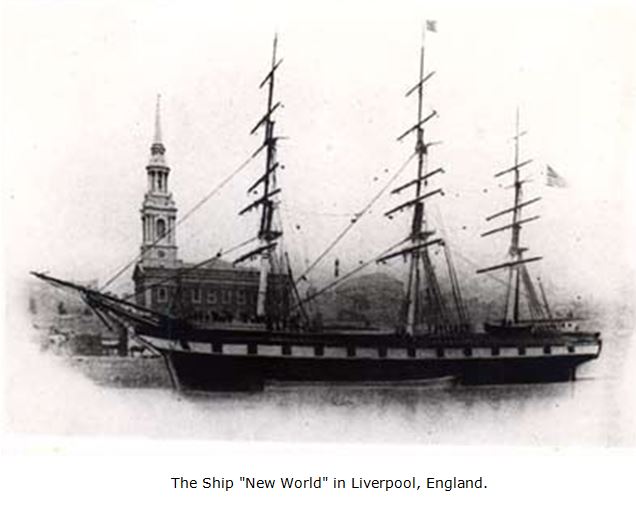
John Smith and his wife, Margaret O’Neill Smith, my 3rd great grandparents, were Irish immigrants who settled in Brooklyn, New York in 1849.  The Irish people and the Irish economy had suffered for several years with famine.  The Smith family boarded the ship “New World” in Liverpool along with over 400 other passengers.  The ship arrived in New York City on September 21, 1849.  According to the ship’s manifest, the Smyth family group included:  John 60 years, Margaret 40 years, Ellen 20 years, Robert 19 years, Joseph 18 years, Francis 16 years, Margaret 15 years, Mary 10 years, and Elizabeth 1 ½ years. 

Before the family emigrated, they had for many years resided in Clones, County Monaghan, Ireland.  John is included in the 1846 local Ireland commercial business directory where he is listed as “John Smith, coach & car maker, Cara St, Clones.”  The 1849 ship manifest also listed John with the occupation of coachmaker.   And after arrival in New York, John appears in the census and the 1850-1851 Brooklyn City Directory as a coachmaker.

The family evidently had enough early success to place advertisements in the Brooklyn Daily Eagle newspaper in 1854 for Carriages from Smith & Sons, Carriage Factory.


“Carriages – On hand at SMITH & SON’S Carriage Factory, Myrtle Ave, East Brooklyn, a number of superior light wagons of the newest styles and best material selling 20 per cent cheaper than Broadway and warranted thirty per cent better.”

By 1860, the Smith family business appears in the U.S. Federal Census Non-Population Schedule as a "Carriage Manufactory that produces 30 Light Waggons annually and employs 12 men." 

While the family appears to have enjoyed success during their early years in America, there was also sadness.  In 1854, one of the sons, Francis, died after a lingering illness. He was only 20 years old.

The first half of the 1860’s and the years of the Civil War proved very hard for the Smith family.  Ellen, the eldest daughter, died in 1862 at 28 years.  Only a year later in 1863, John Smith, the family patriarch, died at 70 years.  And in 1864, the husband of another daughter, Margaret Smith King, died after being wounded in battle, leaving her with four young children.  Margaret’s husband had been a carriage painter in the family business prior to joining the Union effort.

By the end of the Civil War, it appears that the family business was gone, and I don’t believe that the Smith family ever recovered.  One son, Joseph, died in 1889 in a Little Sisters of the Poor Home for the Aged in Brooklyn, and I believe that Robert, another son, also died in 1889 in a Little Sisters of the Poor Home.

My family line descends from the youngest child of Margaret Smith King, the young Civil War widow.  This child was only 2 years old when her father died in the War.  The 1870 Census shows Margaret Smith King as a widow with her four children and notes her occupation as “ironing & washing.”

*  *  *  *  *

Key Individuals:

     John Smith  (1790 - 1863)

     Margaret O’Neill Smith  (1802 – 1881) 

        Ellen Smith  (1834 – 1862)

        Robert Smith  (1827/31 – 1889?)

        Joseph Smith  (1828 – 1889)

        Francis Smith  (1830/33 – 1820)

        Margaret Smith King  (1834 – 1862)

Notes: 

As you can imagine, with a name like John Smith, this family has been very difficult to nail down in my genealogy work.  Also, the birth dates for the Smith family are a mess to figure out.  The ages on the passenger manifest, subsequent ages on censuses, and ages in obituaries and death certificates all have a wide variance.  In the end, it is only a guess.

For more information on the family of Margaret O’Neill Smith, see my May 6, 2020 blog post “Obituary Clue.”

A future blog post will share the story of Margaret Smith King’s husband and his Civil War experience.

- Jane Scribner McCrary

August 20, 2020

Year as a Union Prisoner

Joseph Hughes, my 2nd great grandfather, was born and raised on a small farm in Camden County, North Carolina.  On May 30, 1861, Joseph enlisted to fight for the Confederacy at the age of 24.  He signed up for a 12-month period as a Private in Capt G G Luke’s Independent Confederate Company.  Joseph was married to Mary “Polly” Gibson, and possibly they had married just prior to his enlistment.  The marriage could have been escalated by the war that had just begun.  Only weeks earlier on April 12th, the Confederates had bombarded Union soldiers at Fort Sumter, South Carolina.

Family history notes written in the 1970’s by my mother’s cousin, Esther Rippard Bradshaw, stated that Joseph Hughes “was captured by the Yanks at Hatteras and returned home a year later” – a comment I was able to verify only in recent years as a great many Civil War records have been added to online digital collections.

By late August of 1861, just three months after enlisting, Joseph Hughes found himself close to home fighting as an infantry soldier in the Battle at Fort Hatteras, North Carolina which was less than 100 miles from Camden.  On August 29th, after an intense battle, the Confederate troops surrendered and the Union experienced its first victory of the Civil War.  There were 691 Confederate soldiers captured at Hatteras and taken as Union prisoners. 

Union records document Joseph Hughes as a prisoner with the rank of Private belonging to the Confederate regiment known as the North Carolina Defenders.  He is recorded as having been captured on August 29, 1861 at Hatteras, North Carolina.  He was indeed “captured by the Yanks.”

Confederate records show that on September 15th, and while still a Union prisoner, Joseph Hughes had been officially transferred out of Capt Luke's Independent Company and into Capt Luke's 1st Company H of the 32nd  Regiment, also known as the North Carolina Defenders.  This transfer appears to have been simply a re-organization of the Confederate troops. 

By November, and still a Union prisoner, Joseph was taken to Fort Warren located on Georges Island in the Boston Harbor in Massachusetts.  Union records reveal that Joseph was paroled at Fort Warren, near Boston, and then transferred for exchange to Fort Monroe, Virginia in December 1861.

Prisoner exchanges between Union and Confederate forces were common early in the Civil War but had mostly ceased by 1863.  I have no information on Joseph’s treatment or conditions of confinement, though times were hard and the northern winter was surely cold and difficult for the southern soldiers. 

After the exchange, Joseph returned to his unit, the 1st Company H, 32nd Regiment of North Carolina, for the remainder of his enlistment term.  Joseph Hughes was included as present and accounted for on the muster roll when the company disbanded on April 2, 1862 at which time he was officially discharged from the Confederate Army.


Joseph’s wife, Mary “Polly” Gibson Hughes was pregnant during the time he was captured and held as a Union prisoner.  On April 7, 1862, my great grandfather, Luke G Hughes was born and named in honor of Joseph’s former commanding officer.  

*  *  *  *  *

Key Individuals:

Joseph Hughes (1836 - 1915)

Mary “Polly” Gibson Hughes (~1837 – ~1870)

Luke G Hughes (1862 – 1959)

Esther Lucille Rippard Bradshaw  (1915 – 1999)

John Hughes (~1802-1866) 

Notes:

Aunt Esther’s family history notes also indicate that John Hughes (Joseph’s father) “had a peg leg”.  Joseph’s death certificate confirms John Hughes as his father, as well as census and probate documents all of which indicate that John was a farmer.  However, I have never found anything about John having lost a leg. 

I would love to hear from anyone who might have more information on this Hughes family.

- Jane Scribner McCrary

Charles Ranlett Flint (1850 - 1934)

I reluctantly ended my blog over a year ago because I felt that I had run out of stories to tell.   However, I said that I might occasionall...