October 14, 2023

My Loving Mom

My Mom was a soft-spoken southern woman.  Ann Hart Hughes was born in 1921 in South Norfolk, Virginia.  She lived in Virginia until she married my father.

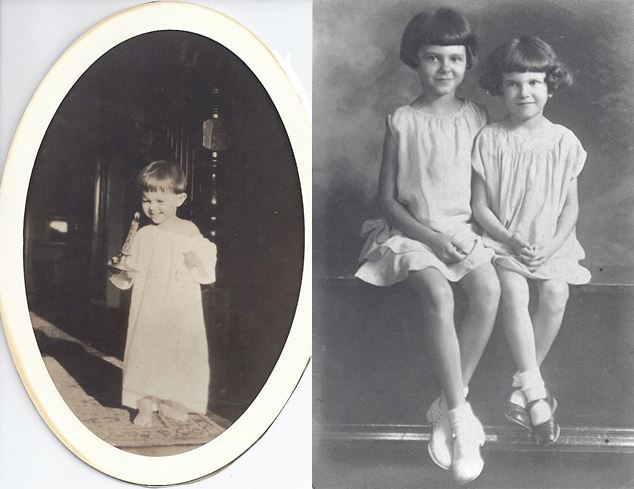
The older of two daughters of Charles Henry Hughes & Nina Cecelia Nash Hughes, Ann had an idyllic, though not wealthy, childhood with her parents in a small home on Decatur Street.  She had one younger sister named Nina Nash Hughes, Aunt Teenie to me, shown in the photo below.


Ann was always a good student who loved writing and English grammar.  After high school she went to Mary Washington College in Fredericksburg, Virginia.  Unfortunately, she broke her foot sometime in her freshman year, had to drop out because of it, and never returned to college.  After Ann’s foot healed enough that she could get back to normal life, she found a job and went to work.

Ann lived at home with her parents and worked for the next eight or so years.  She once told me that if she had lived during my generation, she would have loved to have her own apartment, but that just wasn’t done in her time.  So Ann remained at home and saved her money.  She was 29 by the time she married Dad, and was grateful that her parents always made her feel welcome and loved during those years.

In my father’s memoir, Dad wrote about meeting Mom:

I was the Aviation Supply Officer for my squadron and with that job I had to get the spare parts to keep all the planes flying.  Our source of supply was the Naval Air Station in Norfolk, Virginia; this is where I met Ann Hart Hughes.  She worked in Aviation Supply, and I made a habit of arriving there just about the time she was due for a break so we could have a little time together.  My commanding officer, Col. John L. Smith, found out about all the trips I was making to Norfolk and questioned me about it.  I told him about Ann and a few weeks later he invited me to go along with him and his wife, who knew Ann, to Norfolk – and that really kicked off the love affair.  I knew I had found my soul mate, so in 1948, before being transferred to China, I asked Ann to marry me.  I had leave before shipping to China so I spent some time in Norfolk with Ann and she came with me up to Huntington, Long Island for a few days. “

Ann Hart Hughes and Robert Gordon Scribner married in August of 1949 in Norfolk, Virginia.  They drove to Niagara Falls for their honeymoon, and then back to Edenton, North Carolina to begin their life together.  In Edenton, they purchased a Cape Cod saltbox home in a new subdivision for $6,600.


My Dad’s military career had us moving every couple of years.  They went from Edenton, NC to Cherry Point, NC to Pensacola, FL back to Cherry Point to South Laguna, CA to Quantico, VA back to Pensacola, to Albuquerque, NM, and last to Yuma, AZ.  And during that time they welcomed five children into the family – three boys and two girls.  We always knew that we were an unusual tribe with all seven members of our family born in a different state.  My parents’ final move was when Dad retired from military service and our family settled in Alto, NM in 1963.

For the next 43 years my parents lived in Alto, first on the ranch which was the topic of the blog post Aviator to Rancher that I posted a few weeks ago.  During their later years, my parents sold most of the ranch property, retaining 10 acres on which they built their retirement home.  My parents were true partners in life, always making joint decisions and caring for each other along the way.


I started this blog with the statement that “My Mom was a soft-spoken southern woman” – and she was.  With five children you would think that things would get out of control at times, but my Mom never yelled at us or seemed to get angry.  She would simply give us a “look”, make a calm statement about what needed to change, or send us to our room – and that took care of it.  Mom had a gentle southern accent which I was never aware of until someone would mention it.  To me, she just sounded like my Mom.

A few of my fondest memories of my mother were from trips we took together.  One such trip was when I was about 25 years old and suddenly cast adrift after the sudden death of my first husband.  Both of my parents understood that I needed time to reset and make a new course.  My mom suggested a trip with her to Virginia and North Carolina to visit some of her extended family.  She hadn’t been back east in quite some time and decided that it would be nice for me to get to know more of her side of the family.  It was a wonderful distraction from my sadness, a really good time with my Mom, and the beginning of my lifelong interest in discovering our unique family histories.

*  *  *  *  *

Key individuals:

        Ann Hart Hughes Scribner  (1921 – 2006)

        Robert Gordon Scribner  (1923 – 2006)          

Notes:

Ann struggled with dementia or Alzheimer’s for more than the last decade of her life but remained at home during all those years under Bob’s loving care.

 – Jane Scribner McCrary

September 30, 2023

Aviator to Rancher

The military career of Robert Gordon Scribner, my father, was the subject one of my early blogs [Awarded the Distinguished Flying Cross, posted in May of 2020].  He retired from the U.S. Marine Corps in 1963 after a successful career in aviation with the rank of Lieutenant Colonel, and while he was still in his early 40’s.  He could see that his flying days were coming to an end.  He always said that he retired because he did not really want a desk job.

While stationed at his last assignment in Yuma, Arizona, my parents invested in a ranch in Deming, New Mexico, the Palomas Ranch, and horses started to become a part of our life.  According to Dad, when he was young his parents wanted him to become an engineer like his father.  He was more interested in becoming a veterinarian; however neither of those career choices came to fruition.  Dad went to Virginia Polytechnic Institute in June 1942 to begin studying engineering, and before year end he left to join the Navy V-5 program for pilot training to become an aviator.

Both of my parents were great readers, and had an active mind for continuing education as a lifelong interest.  Dad was a huge proponent of adult education and took numerous classes while in the military on animal husbandry, and the kind of skills that a rancher would need like welding, machinery repair and construction.  Soil & water conservation was also of great interest to Dad.

With over 20 years in military service, my parents made the decision for Dad to retire in 1963.  Before he retired, Mom & Dad looked for property suitable for a small ranch with horses and cattle.  One location that they liked was the area around Ruidoso, New Mexico which we had visited a couple of times on vacations when he was stationed in Albuquerque, New Mexico.  It was cooler than Arizona and a couple of us children with asthma did well in the mountain air – we were five children by the time Dad retired.  No more military life for this family or moving every two years.


High Mesa Ranch in Alto, New Mexico became our new family home along with the business of raising and breeding horses, primarily quarter horses, and black Brangus cattle that roamed the pastures and wooded areas.
 

Growing up on a rural property has its advantages and disadvantages.  As a child there was a lack of nearby friends and playmates.  We were at the end of the line for the school bus which meant that we started early and got home late.  And we all rode that darned school bus until graduation day!  While some of our friends had cars in high school, we were never conveniently located to catch a ride with anyone.  Our parents allowed us to drive the family car into town to run errands or attend school functions, but not on a daily basis to attend school.

I remember so many special times like taking the toboggan out in the snow during the holidays to find a perfect Christmas tree to bring back to our home, dragging us on the toboggan behind a horse for fun, learning to drive on rural roads and taking the car into the pasture so we could drive fast in tight circles, called “donuts” and feel how to handle a car that is out of control, staying up late at night to watch the birth of a new foal, seeing deer and turkey out the windows of our home, and wandering around the woods beneath the house and down to Eagle Creek, a lovely clear mountain stream that bordered our property on one side. 


High Mesa Ranch was mostly pasture land on the mesa top and the wooded acreage down three sides of the mesa.  The ranch was 2 sections of land, a total of 1,280 acres.  The pastures were planted in winter wheat for grazing.  The front section on top of the mesa had an old farmhouse, barn and orchard on the property when our family purchased it, and for many years it was used as a home for a ranch foreman and their family.  The back section of our land was called the School Section and it was mostly wooded until a forest fire in 1967 took out many of the trees, and almost reached our home.


My parents built a new home for our family on one side of the mesa top, and a horse stables and small track on the other side.
  I remember that they used rocks gathered on the ranch for the retaining walls around the house and Mom chose lovely round ones with green moss on them for the three fireplaces; we had three wood-burning fireplaces in our home.  The house was built with oversized pinkish adobe bricks made in Mexico that required a long drive to the border to pick them up as they couldn’t be delivered.

The ranch operation was predominately the raising of Brangus cattle for sale, and breeding and raising horses.  There were two stud horses on the ranch with more than a dozen brood mares at one time. 


The horse stables that were built had 20 stalls, each stall with its own 14’ x 80’ run, and three hay or straw lofts in the middle section along with an office, tack and grain room, and a foaling stall.  There was a small bunkhouse with a window looking into the foaling stall.  They also built a 3/8 mile training track in front of the stables with a four-horse starting gate – and a tongue-in-cheek sign that read High Mesa Downs.

One interesting aspect about the horse stables is that my parents built it with a significant water conservation feature.  The stables building was 375 feet long.  Rain water was collected from the metal roof with rain gutters and directed into an 18,000 gallon cistern.  The rain water was then pumped out of the cistern and available to supply all of the water for the horses, the horse showers, bunk room and other needs.

Additional ranch income came from boarding and exercising race horses that were coming to the Ruidoso Downs Race Track prior to the start of race season or for resting and rehabilitation when needed.  The horses were prepared for the upcoming race season with regular workouts so that they could get acclimated to the higher altitude.  There was also a lot of the initial breaking and training of 2-year-old race horses from first saddle to gate training.

Mom & Dad even had a few horses that raced at the track in Ruidoso Downs, but in the end it wasn’t a profitable endeavor.  Our jockey colors were scarlet and yellow.  I remember thinking that a day at the track was pretty boring.  The race would certainly be exciting, but it would only last a couple of minutes, and then there would be a very long 30-45 minute wait for the next race.  Everyone was busy during that time getting drinks or food and placing bets, but I would just bring a book and read to pass the time. 

After the children were grown, my parents often traveled. They went on trips with a group called the New Mexico Amigos who were business men and women that promoted New Mexico to businesses.  They developed a keen interest in art and were supporters of local artists and southwestern art.  Needlepoint conventions were also on their list of fun things to do – Dad was a great needlepointer and won several ribbons at these events.  When I was about college age I came home with a needlepoint project and brought one for Mom to do as she always enjoyed craft projects as well.  And then before I knew it, Dad was needlepointing!  He found needlepoint to be a great pastime while watching football games or TV.  For a couple of years, it was a family secret and he would put it away if anyone came over.  In the end, he took great pride in his needlepoint projects which were finely executed and often became special gifts for family.

My folks also traveled worldwide with trips to Spain and Egypt.  And they enjoyed many extended vacations in Mexico until Mom’s health began to decline.  New Mexico was home to my parents for much of their long life together. Dad died on January 26, 2006 from heart failure, and Mom died only 2 days later on January 28, 2006 after years of dementia or Alzheimer’s and loving home care from Dad.  Bob & Ann were partners in life and they left this world together as well. 


Mom & Dad had 5 children, 8 grandchildren, and now a growing number of great grandchildren to carry on their legacy. 


Note:  Grandchild, Shane Scribner, not in this photo.

*  *  *  *  * 

Notes:

While this blog is mostly about my Dad; my Mom and I were very close, and I plan to make her the subject of my next blog post.


Key Individuals:

     Robert Gordon Scribner  (1923 – 2006)

     Ann Hart Hughes Scribner  (1921 – 2006)                         

- Jane Scribner McCrary

September 15, 2023

Samuel Justus Hart or Justus Samuel Hart?

In an early blog post, Lost Line from Canada, dated July 18, 2020, I expressed my frustration with the lack of information that I have on my 2nd great grandfather, Samuel Hart.  He was married to Honora (or Hannah) Rouen, and they had two children, Frank and Mary Ann Hart.  See my previous blog post for more on Honora. 

As I noted in that blog post about Samuel Hart, our family lore and notes indicate that Samuel “had lived as an orphan in a lumber camp in Canada.  The cook, who had known his parents, was to tell him about them, but apparently did not before he was killed.”  And my research has not yet revealed anything about Samuel’s parentage.

To revisit, here is what we do know about Samuel Hart:

Samuel Hart was born in Canada. The 1865, 1870, 1875 and 1880 censuses for the Hart family, including his wife and children, all show him to be born in Canada.  Also, the death certificates for both of his children note that their father was born in Canada.

Samuel’s name variations, as noted in documentation, include the following:

Justice Heart – 1865 census; 30 yrs; laborer; w/ Hannah, Francis & Mary A in Schaghticoke, Rensselaer, NY

Samuel Hart – 1870 census; 34 yrs; farm laborer; w/ Hannah, Frank & Mary in Schaghticoke, Rensselaer, NY

Samuel Hart – 1875 census; 44 yrs; farm laborer; w/ Hannah & Mary A (Frank as laborer was 3 houses away) in Schaghticoke, Rensselaer, NY

Samuel Hart – 1880 census; 46 yrs; farmer; w/ Hannah, Francis & Mary in Schaghticoke, Rensselaer, NY

Samuel Hart – per son Frank’s 1916 death certificate

Justus Hart – per daughter Mary Ann’s 1926 death certificate

Justin or Justus Hart – per family notes written in 1977 by Louise Nash Egbert

Most references cite his first name as Samuel and a few as Justus.  My mother had once mentioned that she had been told that he didn’t like his first name.  I’ve always thought of him as Samuel Justus Hart or Samuel J Hart … however maybe his name was actually Justus Samuel Hart?

Samuel Hart was likely born about 1831.  Census records place his birthdate somewhere between 1825 and 1836.  I have found a 1902 death certificate for a Samuel Hart that I believe might be our Samuel.  He died in Troy, NY (where our Samuel’s son, Frank lived) and it lists him as having died at 71 years (i.e. birth year of 1831), occupation as farmer, married, and born in Toronto, Canada.  This death certificate noted that Samuel was buried in Schaghticoke, Rensselaer, NY.  Unfortunately, I haven’t been able to find the place of burial for either Samuel or his wife, Honora/Hannah.  Interestingly, this 1902 death certificate marks the first time that a specific location in Canada has shown up in my research.

Samuel’s primary language was French.  According to family letters, Samuel’s native language was French which he spoke almost exclusively.  And Samuel's wife, Honora was well educated and also fluent in French, though she was born in Ireland.  It is reasonable to assume that Samuel was raised by a French speaking family in Canada.

“About Grandma [Mary Ann Hart] … her Mother was a Rouen and her father was a Hart, who was a French Canadian”  “I believe that I have heard that [Samuel] Hart, the great grandfather spoke very little or no English.  I would presume that the former Miss Rouen must have been bi-lingual to a degree for the matter of communication.”  Source:  Maurice Eugene Nash [great grandson of Samuel Hart & Honora Rouen Hart] family letter; 1963.

And another similar bit of information from family stories:

“I have heard (I can’t remember where) that Grandma Watson [Mary Ann Hart] lived in New York state; that her father [Samuel Hart] raced in the Hudson River Ryatta [sic Regatta].  She was brought up not to have to work but well-trained in all household activities (as her later life would indicate) so she could properly supervise… Grandma [Mary Ann Hart] spoke very little, as far as I can find out, about her family... she loved books and poetry … always Classics.” – Source:  Louise Nash Egbert [great granddaughter of Samuel Hart & Honora Rouen Hart] family letter; 1977.


And now for a course correction.  I mentioned in the Notes section of the Lost Line from Canada 2020 blog post, that at the time I believed that our Samuel Hart might somehow be connected to the notable Hart family that originated in the French speaking area of Quebec in the late 1700’s. 

Aaron Hart (b.1724) and Dorothea Catharine Judah (b.1747) emigrated from England in 1781 and established the prominent Hart family in Quebec.  They had eight children, including four sons, and their extended family grew to be quite large.  At his death in 1800, it was believed that Aaron Hart was the wealthiest citizen in British Canada. 

Aaron Hart has been referred to as the father of Canadian Jewry.  Hart is known to have been an Ashkenazi Jew, and I assume that his wife, Dorothea was Ashkenazi Jewish as well, since she was also Aaron’s cousin.

I was recently reviewing the information that I have on Samuel Hart, when it occurred to me that if Samuel was a descendant of the Canadian Aaron Hart family, then wouldn’t I find some Ashkenazi Jewish ethnicity in my DNA results?  Several years ago I took the Ancestry DNA test, and it does not show an Ashkenazi Jewish DNA component for me. 

At first I thought that might mean that our Samuel Hart doesn’t link to the Ashkenazi Jewish Canadian Hart family line.  However, I discussed this with a distant cousin who is related to me through my same Hart line, and he tells me that he has had his DNA done with five different companies and that two of the five results show traces of Ashkenazi Jewish DNA.  And as you probably already know, the amounts of DNA that each generation can get from a parent can vary greatly.  And of course, if he does have Ashkenazi Jewish DNA in his line, we currently have no way of determining if it is in the Hart segments.

Thus, with the information that I have today, I really can’t establish that our Samuel Hart descends from the Ashkenazi Jewish Canadian Hart family founded by Aaron and Dorothea Hart.  If anyone else in my Hart family line has taken a DNA test, I would love to hear from you as to whether you see any Ashkenazi ethnicity or not in your results.

*  *  *  *  *

Key Individuals:

Samuel J Hart  (abt 1830 – 1902?)

Honora Rouen or Hannah Roughan  (abt 1830 – unknown) 

       Francis/Frank Hart  (1861 – 1916)

       Mary Ann Hart Nash Watson  (1862 – 1926)

Jane Scribner McCrary

August 15, 2023

More on the Dickinson Family home

Earlier this year, I wrote a blog titled Researching the Dickinson Family Home [posted on March 31, 2023] about the New London home that belonged to Nathaniel & Elisabeth Dickinson, my 4th great grandparents.  At the time I lamented that I would like to get ahold of any related land records or deeds so that I could ascertain whether Nathaniel Dickinson built the home or purchased it on or before 1794 when he received a loan using the home as collateral which was included in his probate paperwork.

After the blog was posted, my cousin Lynn suggested that I might try and see if the local historical society would know someone who could go to the courthouse and look for any records – a great idea!  I did just that and later received copies of 4 different documents relating to the Dickinson family ownership of their New London home and surrounding land.

While I still didn’t get an answer to my question as to when the large Dickinson family home was built, I did get a little more detail on the timeline of the property itself.  We know that the Dickinson family "lived" on the property as early as 1781, but I am not sure if they lived in the mansion home then, or possibly another home on the property acreage.

Below is a timeline that I detailed from the information that I presently have:

Prior to 1778 – Nathaniel Dickinson of New London was briefly married.  According to letters written by Jonathan Brooks, Jr to Nathaniel's son, David Bill Dickinson, "Capt Nathaniel Dickinson married for his first wife a Miss Roland of Lyme State of Connecticut the Daughter of a Wealthy Farmer..."

1778-1779 – Nathaniel Dickinson married Elisabeth Bill, both of New London.

1781 – Nathaniel Dickinson apparently already owned property near the New London shipping area and according to family letters Nathaniel “was at home with his family” when the British raided and set fire to colonial property in the port areas of both New London and Groton, Connecticut in 1781.  In May of 1792, Nathaniel was awarded 15.1.0 British pounds by the Connecticut General Assembly in recompense for his damages during the 1781 British attack on New London’s shipping businesses.  It is likely that at least his shop was burned or damaged in the raid.

1792 Sept 24 – Nathaniel Dickinson of New London received 20 British pounds from Timothy Green of New London for the sale of land that was described as a strip 8 feet wide and located from his shop to Main Street on the north side of where his home was located.

1794 Oct 10 – Nathaniel Dickinson signed a mortgage note for 27.6.9 British pounds.  He appears to have used his home as collateral for this note.  The funds were possibly obtained to build or enlarge the Dickinson family home or used for his business as a supplier for ships in New London.  This note was paid off and cleared when Nathaniel’s estate was probated.

1797 January – Nathaniel Dickinson died at sea on a voyage home to New London.  His estate left everything to his widow, Elisabeth.  Probate began in 1797 but wasn’t finally settled until 1806.  The property was recorded as a “Mansion House & Lot of Land with a small old shop” and it seemed to stretch the full width of the block with the shop at the end near of the wharf area & shipping center in New London.

1803 June 16 – Mrs Elizabeth Dickinson of New London leased a small parcel of land to Samuel Green of New London for the sum of $8 per year.  This plot of land was described as the south part of her garden.

1806 Sept 12 – In a $300 settlement of the Estate of Nathaniel Dickinson of New London, Elizabeth Dickinson granted/sold land to Peter Beebe of New London.  It sounds like this might have been for the eastern portion of the land with the shop on it that was nearest the shipping area.  It did not include her home.  The Beebe family was very active with early shipping in New London.

1815 August 14 – Elisabeth Dickinson of New London received $88 from Stephen Peck of New London and released to him title to land and a dwelling house that she had inherited from her husband, Nathaniel.  This document notes in the description that it is bounded on the northern and western sides by land owned by Joseph Bollis, bounded to the south by land owned by Joseph Peck, and to the east by Main Street.  BUT, the west side of the Dickinson home was along Main Street. So … either this was the sale of the Dickinson family home with an error in the description, or possibly it might have been property located across Main Street from the Dickinson family and an earlier home on the Dickinson property that also belonged to Nathaniel.     

1819 March – The house “lately occupied by Elizabeth Dickinson, situated on Main” was advertised for rent by Benjamin Brown of New London in 1819.  It is possible that Nathaniel & Elisabeth’s son, Capt David Bill Dickinson, had arranged for his brother-in-law, Benjamin Brown, to manage the property if it was still owned by the family at that time.  Or, if the property was no longer held by the Dickinson family, then as a local business man, Benjamin Brown was managing it for himself or another.

We still don’t know when the Dickinson family (probably either Elisabeth Dickinson or her son, David Bill Dickinson) finally sold the home on Main Street.  And I also don’t know when Elisabeth died, though it must have been after August 1815 as she signed the 1815 document noted above. 

Unfortunately, I haven’t found probate papers, a death notice or even a burial plot for Elisabeth Bill Dickinson – any of which would answer more of my questions.

*  *  *  *  *

Key Individuals: 

   Nathaniel Dickinson (1749 – 1797)

   Elisabeth Bill (~1760 – ~1818)

David Bill Dickinson (1787 – 1846)


Notes:

In case you want to see the document images, below are copies and partial transcriptions of the 4 documents that are cited above that were recently obtained from the office of the New London Town Records.


1792 Sept 24 – Nathaniel Dickinson of New London received 20 British pounds from Timothy Green of New London for the sale of land described as:

“a certain piece of Land lying on the South Side of my Garden, viz – Beginning at the Southwesterly Corner of my Garden in New London & North of Green’s Land, therein running Northerly as the Fence runs between my Land and William Skinner or Thomas Shaw’s Lane eight feet & two inches to the North Side of a large white Oak Post, thence remaining on a Straight Line Easterly to the Main Street to a Meer Stone five Inches South of the Southwest Corner of my Shop which is the Division between Green’s & my Land on the East Bound thence running Westerly bounding Southerly on Green’s Lane to the first mentioned Bound, about sixty seven feet.” [recorded, page 221, Vol 26, New London Town Records]


1803 June 16 – Mrs Elizabeth Dickinson of New London leased a small parcel of her land described as a garden to Samuel Green of New London for the sum of $8 per year

“a Certain piece of Land being the South part of my Garden, description as follows, viz / Beginning at the North End of the Brick Building thence running ten feet, sixteen inches North thence West four feet thirteen inches thence North two feet ten Inches & half thence West thrity six feet, thence South by Land of Joseph Skinner Fourteen feet five Inches to Lane of Ann W Green P Green shall from time to time & at times During P Time hereby Granted peacably Occupying hold and Enjoy P Land without any Let Trouble or hindrance of P Elizabeth Dickinson or any Other person or persons Lawfully claiming by from or under her or by her Means or Procurement.  It is further agreed by P. Elizabeth & Samuel that after the Expiration of Six Years from the above Date, I Said Elizabeth her heirs or should wish to build on any part of the Lane hereby Leased the whole of P Land to be Given up if Requested and P Green to Move the fence to the Original Bounds to the Line of P Ann W Green.” Note: I believe that “P” means Party to this contract. [recorded, page 159, Vol 31, New London Town Records]

1806 Sept 12 – In settlement of $300 from the Estate of Nathaniel Dickinson of New London, Elizabeth Dickinson of New London sold land to Peter Beebe P of New London described as:

“a Certain Piece of Land lying within New London & is Bounded as follows viz beginning of the Northeast Corner of the Brick Building belonging to Ann W Peck, Lately Ann W Green thence westerly by Land of P Skinner to a Meer Stone marked with the Letter A. thence Easterly 42 feet to a Meer Stone.  Near the Southwest Corner of P Dickinson House to Meer Stone being twelve feets & a half Northerly of P Brick Building & Marked with the letter B thence Easterly to a Meer Stone Marked C to the Line of the Highway thence Southerly 14 feet to the First Mentioned bound.  P Beebe to have the use? of a Gang Way two & a half feet wide the bredth of P Dickinson’s House for the purpose of passing North of his Shop to Make Repairs _?_.  It is clearly Understood by the Contracting parties that P Beebe is Not to Come Into possession of that part of the Land Conveyed by this Instrument which is Covered by a Lease to Coll. Samuel Green Until the Expiration of P Lease the Land above described & Conveyed Is a part of the Lott on which the House of my Late Husband Nathaniel Now Stands & the same which he purchased of the Honble Richard Law Esq. Which Land I sell by Order of the Court of Probate.”  Note: a meer stone is a boundary marker.

1815 August 14 – Elisabeth Dickinson of New London received $88 from Stephen Peck of New London and released to him title to land and a dwelling house that she had inherited from her husband, Nathaniel:

“in and to a certain lot of Land being and situate in said New London with a dwelling House thereon standing bounded northerly of Land of Joseph Bollis, westerly by land of Joseph Bollis, southerly by Land of said Stephen Peck, and Easterly by the Main Street being all my right in and to the Estate of my deceased Husband Nath Dickinson.  [recorded, page 141 of Volume 36, New London Town Records]

– Jane Scribner McCrary


August 1, 2023

More about the “Henry B Hyde” fire

I have discovered that you can currently get free online access to the digital records at The National Archives https://catalog.archives.gov/. In the past we would have to submit and pay for a research request and wait to see what could be found.  So as you might expect, I spent some time searching around for anything related to our family history.

While I didn’t find any new information or revelations, I did find an interesting 1900 communique from the United States Consul in Valparaiso, Chile to the State Department regarding the fire aboard the ship Henry B Hyde that was the topic of my April 30, 2021 blog post, Dangerous Fire Aboard a Clipper Ship about Captain David A Scribner’s last sea voyage.  I will share a few of the pages with you.


*  *  *  *  *

Key Individuals:

       David Alba Scribner  (1840 – 1911)

- Jane Scribner McCrary
1 August 2023

Charles Ranlett Flint (1850 - 1934)

I reluctantly ended my blog over a year ago because I felt that I had run out of stories to tell.   However, I said that I might occasionall...